

MuleSoft MCPA-Level-1-Maintenance Real Exam Questions Test Engine Dumps Training With 81 Questions
MCPA-Level-1-Maintenance Actual Questions Answers PDF 100% Cover Real Exam Questions
Passing the MCPA-Level-1-Maintenance exam validates that the candidate has up-to-date knowledge and skills in designing and developing integration solutions using the Anypoint Platform. It also demonstrates their commitment to maintaining their expertise and staying current with the latest advancements in MuleSoft's technology. Additionally, maintaining their MCPA-Level-1 certification helps professionals stand out in the job market and opens up opportunities for career growth and advancement.
The MCPA-Level-1-Maintenance exam is focused on testing the candidate's ability to maintain and optimize existing MuleSoft integration projects. MCPA-Level-1-Maintenance exam covers topics such as troubleshooting, monitoring, and performance tuning of MuleSoft applications. It also tests the candidate's understanding of best practices for maintaining and updating MuleSoft applications to ensure their continued reliability and functionality.
MuleSoft MCPA-Level-1-Maintenance exam is an online, proctored exam that tests the candidate’s knowledge of MuleSoft’s latest updates and trends. MCPA-Level-1-Maintenance exam is designed to evaluate the candidate’s ability to design, develop, and deploy MuleSoft-based solutions. MCPA-Level-1-Maintenance exam covers a wide range of topics, including MuleSoft API-led connectivity, MuleSoft Anypoint Platform, MuleSoft architecture, and MuleSoft deployment.
NEW QUESTION # 38
An organization wants to make sure only known partners can invoke the organization's APIs. To achieve this security goal, the organization wants to enforce a Client ID Enforcement policy in API Manager so that only registered partner applications can invoke the organization's APIs. In what type of API implementation does MuleSoft recommend adding an API proxy to enforce the Client ID Enforcement policy, rather than embedding the policy directly in the application's JVM?
- A. A Mule 3 application using APIkit
- B. A Non-Mule application
- C. A Mule 3 or Mule 4 application modified with custom Java code
- D. A Mule 4 application with an API specification
Answer: B
Explanation:
A Non-Mule application
*****************************************
>> All type of Mule applications (Mule 3/ Mule 4/ with APIkit/ with Custom Java Code etc) running on Mule Runtimes support the Embedded Policy Enforcement on them.
>> The only option that cannot have or does not support embedded policy enforcement and must have API Proxy is for Non-Mule Applications.
So, Non-Mule application is the right answer.
NEW QUESTION # 39
A Mule application exposes an HTTPS endpoint and is deployed to the CloudHub Shared Worker Cloud. All traffic to that Mule application must stay inside the AWS VPC.
To what TCP port do API invocations to that Mule application need to be sent?
- A. 0
- B. 1
- C. 2
- D. 3
Answer: D
Explanation:
8082
*****************************************
>> 8091 and 8092 ports are to be used when keeping your HTTP and HTTPS app private to the LOCAL VPC respectively.
>> Above TWO ports are not for Shared AWS VPC/ Shared Worker Cloud.
>> 8081 is to be used when exposing your HTTP endpoint app to the internet through Shared LB
>> 8082 is to be used when exposing your HTTPS endpoint app to the internet through Shared LB So, API invocations should be sent to port 8082 when calling this HTTPS based app.
References:
https://docs.mulesoft.com/runtime-manager/cloudhub-networking-guide
https://help.mulesoft.com/s/article/Configure-Cloudhub-Application-to-Send-a-HTTPS-Request-Directly-to-Ano
https://help.mulesoft.com/s/question/0D52T00004mXXULSA4/multiple-http-listerners-on-cloudhub-one-with-p
NEW QUESTION # 40
Refer to the exhibit.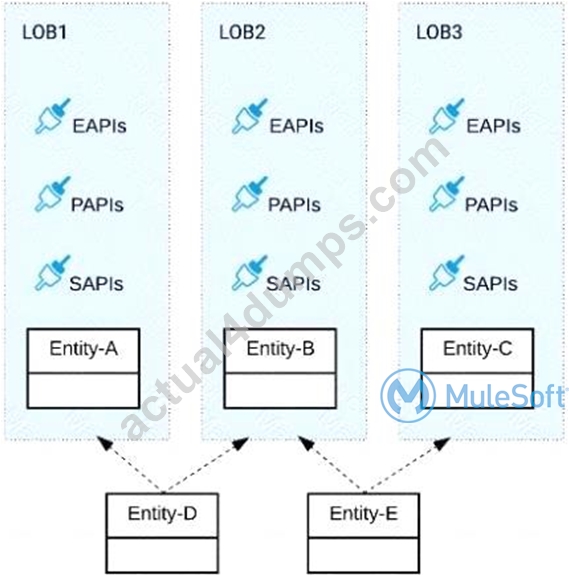
Three business processes need to be implemented, and the implementations need to communicate with several different SaaS applications.
These processes are owned by separate (siloed) LOBs and are mainly independent of each other, but do share a few business entities. Each LOB has one development team and their own budget In this organizational context, what is the most effective approach to choose the API data models for the APIs that will implement these business processes with minimal redundancy of the data models?
A) Build several Bounded Context Data Models that align with coherent parts of the business processes and the definitions of associated business entities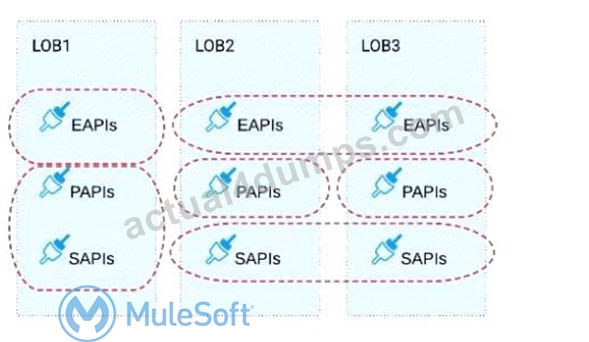
B) Build distinct data models for each API to follow established micro-services and Agile API-centric practices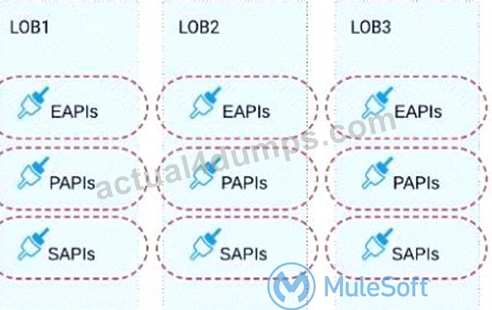
C) Build all API data models using XML schema to drive consistency and reuse across the organization
D) Build one centralized Canonical Data Model (Enterprise Data Model) that unifies all the data types from all three business processes, ensuring the data model is consistent and non-redundant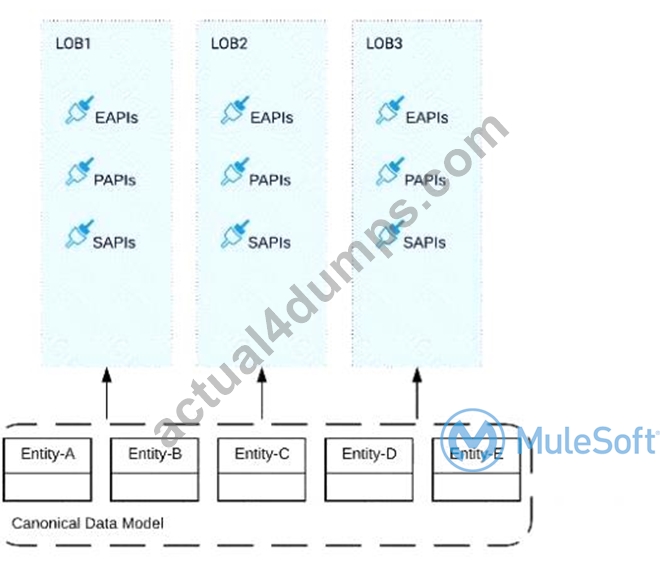
- A. Option A
- B. Option C
- C. Option D
- D. Option B
Answer: A
Explanation:
Build several Bounded Context Data Models that align with coherent parts of the business processes and the definitions of associated business entities.
*****************************************
>> The options w.r.t building API data models using XML schema/ Agile API-centric practices are irrelevant to the scenario given in the question. So these two are INVALID.
>> Building EDM (Enterprise Data Model) is not feasible or right fit for this scenario as the teams and LOBs work in silo and they all have different initiatives, budget etc.. Building EDM needs intensive coordination among all the team which evidently seems not possible in this scenario.
So, the right fit for this scenario is to build several Bounded Context Data Models that align with coherent parts of the business processes and the definitions of associated business entities.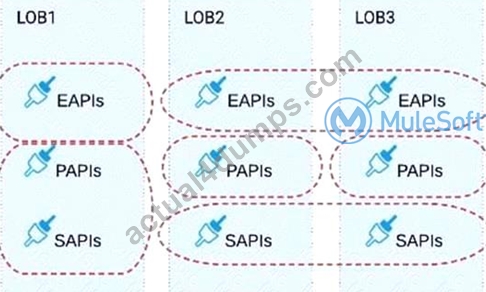
NEW QUESTION # 41
Due to a limitation in the backend system, a system API can only handle up to 500 requests per second. What is the best type of API policy to apply to the system API to avoid overloading the backend system?
- A. Rate limiting
- B. Rate limiting - SLA based
- C. HTTP caching
- D. Spike control
Answer: D
Explanation:
Spike control
*****************************************
>> First things first, HTTP Caching policy is for purposes different than avoiding the backend system from overloading. So this is OUT.
>> Rate Limiting and Throttling/ Spike Control policies are designed to limit API access, but have different intentions.
>> Rate limiting protects an API by applying a hard limit on its access.
>> Throttling/ Spike Control shapes API access by smoothing spikes in traffic.
That is why, Spike Control is the right option.
NEW QUESTION # 42
A company requires Mule applications deployed to CloudHub to be isolated between non-production and production environments. This is so Mule applications deployed to non-production environments can only access backend systems running in their customer-hosted non-production environment, and so Mule applications deployed to production environments can only access backend systems running in their customer-hosted production environment. How does MuleSoft recommend modifying Mule applications, configuring environments, or changing infrastructure to support this type of per-environment isolation between Mule applications and backend systems?
- A. Configure firewall rules in the infrastructure inside each customer-hosted environment so that only IP addresses from the corresponding Anypoint Platform environments are allowed to communicate with corresponding backend systems
- B. Modify properties of Mule applications deployed to the production Anypoint Platform environments to prevent access from non-production Mule applications
- C. Create non-production and production environments in different Anypoint Platform business groups
- D. Create separate Anypoint VPCs for non-production and production environments, then configure connections to the backend systems in the corresponding customer-hosted environments
Answer: D
Explanation:
Create separate Anypoint VPCs for non-production and production environments, then configure connections to the backend systems in the corresponding customer-hosted environments.
*****************************************
>> Creating different Business Groups does NOT make any difference w.r.t accessing the non-prod and prod customer-hosted environments. Still they will be accessing from both Business Groups unless process network restrictions are put in place.
>> We need to modify or couple the Mule Application Implementations with the environment. In fact, we should never implements application coupled with environments by binding them in the properties. Only basic things like endpoint URL etc should be bundled in properties but not environment level access restrictions.
>> IP addresses on CloudHub are dynamic until unless a special static addresses are assigned. So it is not possible to setup firewall rules in customer-hosted infrastrcture. More over, even if static IP addresses are assigned, there could be 100s of applications running on cloudhub and setting up rules for all of them would be a hectic task, non-maintainable and definitely got a good practice.
>> The best practice recommended ), is to have your Anypoint VPCs
seperated for Prod and Non-Prod and perform the VPC peering or VPN tunneling for these Anypoint VPCs to respective Prod and Non-Prod customer-hosted environment networks.
NEW QUESTION # 43
A retail company is using an Order API to accept new orders. The Order API uses a JMS queue to submit orders to a backend order management service. The normal load for orders is being handled using two (2) CloudHub workers, each configured with 0.2 vCore. The CPU load of each CloudHub worker normally runs well below 70%. However, several times during the year the Order API gets four times (4x) the average number of orders. This causes the CloudHub worker CPU load to exceed 90% and the order submission time to exceed 30 seconds. The cause, however, is NOT the backend order management service, which still responds fast enough to meet the response SLA for the Order API. What is the MOST resource-efficient way to configure the Mule application's CloudHub deployment to help the company cope with this performance challenge?
- A. Use a horizontal CloudHub autoscaling policy that triggers on CPU utilization greater than 70%
- B. Use a vertical CloudHub autoscaling policy that triggers on CPU utilization greater than 70%
- C. Permanently increase the size of each of the two (2) CloudHub workers by at least four times (4x) to one (1) vCore
- D. Permanently increase the number of CloudHub workers by four times (4x) to eight (8) CloudHub workers
Answer: A
Explanation:
Use a horizontal CloudHub autoscaling policy that triggers on CPU utilization greater than
70%
*****************************************
The scenario in the question is very clearly stating that the usual traffic in the year is pretty well handled by the existing worker configuration with CPU running well below 70%. The problem occurs only "sometimes" occasionally when there is spike in the number of orders coming in.
So, based on above, We neither need to permanently increase the size of each worker nor need to permanently increase the number of workers. This is unnecessary as other than those "occasional" times the resources are idle and wasted.
We have two options left now. Either to use horizontal Cloudhub autoscaling policy to automatically increase the number of workers or to use vertical Cloudhub autoscaling policy to automatically increase the vCore size of each worker.
Here, we need to take two things into consideration:
1. CPU
2. Order Submission Rate to JMS Queue
>> From CPU perspective, both the options (horizontal and vertical scaling) solves the issue. Both helps to bring down the usage below 90%.
>> However, If we go with Vertical Scaling, then from Order Submission Rate perspective, as the application is still being load balanced with two workers only, there may not be much improvement in the incoming request processing rate and order submission rate to JMS queue. The throughput would be same as before.
Only CPU utilization comes down.
>> But, if we go with Horizontal Scaling, it will spawn new workers and adds extra hand to increase the throughput as more workers are being load balanced now. This way we can address both CPU and Order Submission rate.
Hence, Horizontal CloudHub Autoscaling policy is the right and best answer.
NEW QUESTION # 44
Mule applications that implement a number of REST APIs are deployed to their own subnet that is inaccessible from outside the organization.
External business-partners need to access these APIs, which are only allowed to be invoked from a separate subnet dedicated to partners - called Partner-subnet. This subnet is accessible from the public internet, which allows these external partners to reach it.
Anypoint Platform and Mule runtimes are already deployed in Partner-subnet. These Mule runtimes can already access the APIs.
What is the most resource-efficient solution to comply with these requirements, while having the least impact on other applications that are currently using the APIs?
- A. Add an additional endpoint to each API for partner-enablement consumption
- B. Redeploy the API implementations to the same servers running the Mule runtimes
- C. Duplicate the APIs as Mule applications, then deploy them to the Mule runtimes
- D. Implement (or generate) an API proxy Mule application for each of the APIs, then deploy the API proxies to the Mule runtimes
Answer: D
NEW QUESTION # 45
An Order API must be designed that contains significant amounts of integration logic and involves the invocation of the Product API.
The power relationship between Order API and Product API is one of "Customer/Supplier", because the Product API is used heavily throughout the organization and is developed by a dedicated development team located in the office of the CTO.
What strategy should be used to deal with the API data model of the Product API within the Order API?
- A. Work with the API data types of the Product API directly when implementing the integration logic of the Order API such that the Order API uses the same (unchanged) data types as the Product API
- B. Convince the development team of the Product API to adopt the API data model of the Order API such that the integration logic of the Order API can work with one consistent internal data model
- C. Implement an anti-corruption layer in the Order API that transforms the Product API data model into internal data types of the Order API
- D. Start an organization-wide data modeling initiative that will result in an Enterprise Data Model that will then be used in both the Product API and the Order API
Answer: C
Explanation:
Convince the development team of the product API to adopt the API data model of the Order API such that integration logic of the Order API can work with one consistent internal data model
*****************************************
Key details to note from the given scenario:
>> Power relationship between Order API and Product API is customer/supplier So, as per below rules of "Power Relationships", the caller (in this case Order API) would request for features to the called (Product API team) and the Product API team would need to accomodate those requests.
NEW QUESTION # 46
A company wants to move its Mule API implementations into production as quickly as possible. To protect access to all Mule application data and metadata, the company requires that all Mule applications be deployed to the company's customer-hosted infrastructure within the corporate firewall. What combination of runtime plane and control plane options meets these project lifecycle goals?
- A. iPaaS provisioned customer-hosted runtime plane and MuleSoft-hosted control plane
- B. Manually provisioned customer-hosted runtime plane and customer-hosted control plane
- C. MuleSoft-hosted runtime plane and customer-hosted control plane
- D. Manually provisioned customer-hosted runtime plane and MuleSoft-hosted control plane
Answer: B
Explanation:
Manually provisioned customer-hosted runtime plane and customer-hosted control plane
*****************************************
There are two key factors that are to be taken into consideration from the scenario given in the question.
>> Company requires both data and metadata to be resided within the corporate firewall
>> Company would like to go with customer-hosted infrastructure.
Any deployment model that is to deal with the cloud directly or indirectly (Mulesoft-hosted or Customer's own cloud like Azure, AWS) will have to share atleast the metadata.
Application data can be controlled inside firewall by having Mule Runtimes on customer hosted runtime plane. But if we go with Mulsoft-hosted/ Cloud-based control plane, the control plane required atleast some minimum level of metadata to be sent outside the corporate firewall.
As the customer requirement is pretty clear about the data and metadata both to be within the corporate firewall, even though customer wants to move to production as quickly as possible, unfortunately due to the nature of their security requirements, they have no other option but to go with manually provisioned customer-hosted runtime plane and customer-hosted control plane.
NEW QUESTION # 47
Refer to the exhibit. An organization is running a Mule standalone runtime and has configured Active Directory as the Anypoint Platform external Identity Provider. The organization does not have budget for other system components.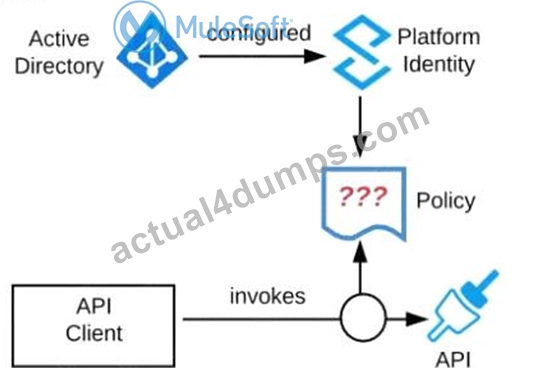
What policy should be applied to all instances of APIs in the organization to most effecuvelyKestrict access to a specific group of internal users?
- A. Apply a client ID enforcement policy; the specific group of users will configure their client applications to use their specific client credentials
- B. Apply an OAuth 2.0 access token enforcement policy; the internal Active Directory will be configured as the OAuth server
- C. Apply a basic authentication - LDAP policy; the internal Active Directory will be configured as the LDAP source for authenticating users
- D. Apply an IP whitelist policy; only the specific users' workstations will be in the whitelist
Answer: C
Explanation:
Apply a basic authentication - LDAP policy; the internal Active Directory will be configured as the LDAP source for authenticating users.
*****************************************
>> IP Whitelisting does NOT fit for this purpose. Moreover, the users workstations may not necessarily have static IPs in the network.
>> OAuth 2.0 enforcement requires a client provider which isn't in the organizations system components.
>> It is not an effective approach to let every user create separate client credentials and configure those for their usage.
The effective way it to apply a basic authentication - LDAP policy and the internal Active Directory will be configured as the LDAP source for authenticating users.
NEW QUESTION # 48
An organization has implemented a Customer Address API to retrieve customer address information. This API has been deployed to multiple environments and has been configured to enforce client IDs everywhere.
A developer is writing a client application to allow a user to update their address. The developer has found the Customer Address API in Anypoint Exchange and wants to use it in their client application.
What step of gaining access to the API can be performed automatically by Anypoint Platform?
- A. Request access to the appropriate API Instances deployed to multiple environments using the client application's credentials
- B. Approve the client application request for the chosen SLA tier
- C. Modify the client application to call the API using the client application's credentials
- D. Create a new application in Anypoint Exchange for requesting access to the API
Answer: B
Explanation:
Approve the client application request for the chosen SLA tier
*****************************************
>> Only approving the client application request for the chosen SLA tier can be automated
>> Rest of the provided options are not valid
NEW QUESTION # 49
Once an API Implementation is ready and the API is registered on API Manager, who should request the access to the API on Anypoint Exchange?
- A. API Consumer
- B. API Client
- C. None
- D. Both
Answer: A
Explanation:
API Consumer
*****************************************
>> API clients are piece of code or programs that use the client credentials of API consumer but does not directly interact with Anypoint Exchange to get the access
>> API consumer is the one who should get registered and request access to API and then API client needs to use those client credentials to hit the APIs So, API consumer is the one who needs to request access on the API from Anypoint Exchange
NEW QUESTION # 50
An organization wants MuleSoft-hosted runtime plane features (such as HTTP load balancing, zero downtime, and horizontal and vertical scaling) in its Azure environment. What runtime plane minimizes the organization's effort to achieve these features?
- A. Anypoint Platform for Pivotal Cloud Foundry
- B. Anypoint Runtime Fabric
- C. A hybrid combination of customer-hosted and MuleSoft-hosted Mule runtimes
- D. CloudHub
Answer: B
Explanation:
Anypoint Runtime Fabric
*****************************************
>> When a customer is already having an Azure environment, It is not at all an ideal approach to go with hybrid model having some Mule Runtimes hosted on Azure and some on MuleSoft. This is unnecessary and useless.
>> CloudHub is a Mulesoft-hosted Runtime plane and is on AWS. We cannot customize to point CloudHub to customer's Azure environment.
>> Anypoint Platform for Pivotal Cloud Foundry is specifically for infrastructure provided by Pivotal Cloud Foundry
>> Anypoint Runtime Fabric is right answer as it is a container service that automates the deployment and orchestration of Mule applications and API gateways. Runtime Fabric runs within a customer-managed infrastructure on AWS, Azure, virtual machines (VMs), and bare-metal servers.
-Some of the capabilities of Anypoint Runtime Fabric include:
-Isolation between applications by running a separate Mule runtime per application.
-Ability to run multiple versions of Mule runtime on the same set of resources.
-Scaling applications across multiple replicas.
-Automated application fail-over.
-Application management with Anypoint Runtime Manager.
NEW QUESTION # 51
What is a typical result of using a fine-grained rather than a coarse-grained API deployment model to implement a given business process?
- A. A higher number of discoverable API-related assets in the application network
- B. An overall tower usage of resources because each fine-grained API consumes less resources
- C. A better response time for the end user as a result of the APIs being smaller in scope and complexity
- D. A decrease in the number of connections within the application network supporting the business process
Answer: A
Explanation:
A higher number of discoverable API-related assets in the application network.
*****************************************
>> We do NOT get faster response times in fine-grained approach when compared to coarse-grained approach.
>> In fact, we get faster response times from a network having coarse-grained APIs compared to a network having fine-grained APIs model. The reasons are below.
Fine-grained approach:
1. will have more APIs compared to coarse-grained
2. So, more orchestration needs to be done to achieve a functionality in business process.
3. Which means, lots of API calls to be made. So, more connections will needs to be established. So, obviously more hops, more network i/o, more number of integration points compared to coarse-grained approach where fewer APIs with bulk functionality embedded in them.
4. That is why, because of all these extra hops and added latencies, fine-grained approach will have bit more response times compared to coarse-grained.
5. Not only added latencies and connections, there will be more resources used up in fine-grained approach due to more number of APIs.
That's why, fine-grained APIs are good in a way to expose more number of resuable assets in your network and make them discoverable. However, needs more maintenance, taking care of integration points, connections, resources with a little compromise w.r.t network hops and response times.
NEW QUESTION # 52
What is a key requirement when using an external Identity Provider for Client Management in Anypoint Platform?
- A. To invoke OAuth 2.0-protected APIs managed by Anypoint Platform, API clients must submit access tokens issued by that same Identity Provider
- B. The application network must include System APIs that interact with the Identity Provider
- C. APIs managed by Anypoint Platform must be protected by SAML 2.0 policies
- D. Single sign-on is required to sign in to Anypoint Platform
Answer: A
Explanation:
Explanation
https://www.folkstalk.com/2019/11/mulesoft-integration-and-platform.html Explanation
To invoke OAuth 2.0-protected APIs managed by Anypoint Platform, API clients must
submit access tokens issued by that same Identity Provider
*****************************************
>> It is NOT necessary that single sign-on is required to sign in to Anypoint Platform because we are using an external Identity Provider for Client Management
>> It is NOT necessary that all APIs managed by Anypoint Platform must be protected by SAML 2.0 policies because we are using an external Identity Provider for Client Management
>> Not TRUE that the application network must include System APIs that interact with the Identity Provider because we are using an external Identity Provider for Client Management Only TRUE statement in the given options is - "To invoke OAuth 2.0-protected APIs managed by Anypoint Platform, API clients must submit access tokens issued by that same Identity Provider" References:
https://docs.mulesoft.com/api-manager/2.x/external-oauth-2.0-token-validation-policy
https://blogs.mulesoft.com/dev/api-dev/api-security-ways-to-authenticate-and-authorize/
NEW QUESTION # 53
......
Actual4Dumps MCPA-Level-1-Maintenance Exam Practice Test Questions: https://www.actual4dumps.com/MCPA-Level-1-Maintenance-study-material.html