

CTAL-TTA Self-Study Guide for Becoming an Certified Tester Advanced Level Technical Test Analyst Expert
CTAL-TTA Study Guide Realistic Verified CTAL-TTA Dumps
NEW QUESTION # 32
You are asked to provide a practical and pragmatic testing solution for a commercial system where the main user interface is via the Internet. It is critical that the company's existing good name and market profile are not damaged in any way. Time to market is not a critical issue when appropriate testing solutions are identified to mitigate business risks.
A product risk assessment has revealed the following product risk:
* Abnormal application termination due to connection failure of the main interface.
Which of the following is the appropriate test type to address this risk?
- A. Portability testing
- B. Operability testing
- C. Reliability testing
- D. Performance efficiency testing
Answer: C
Explanation:
Reliability testing is the process of checking whether the software consistently performs according to its specifications. For a commercial system with a critical internet-based user interface, ensuring that the application can handle connection failures without abnormal terminations is essential. Reliability testing would include testing the system's ability to recover from failures and continue operating, which directly addresses the risk identified.
NEW QUESTION # 33
You are working on a complex systems integration project that will soon be deployed to the production environment. This system is replacing a system that was popular with the users and had no outstanding non-functional issues. There are multiple components that interact and these have been developed by various development and testing groups including some outsourced groups. You will be leading the performance testing effort. Although you would prefer to have a dedicated test system for this effort, you will have to use the production system. You can do this testing at a low usage time, but there will be some users on the system and you will be using real data for the tests. You are now planning your performance testing. Unfortunately, there are no requirements for the performance requirements of the system. How do you determine the acceptable performance levels for the various operational profiles?
- A. You should check the performance of the legacy system and use that as a benchmark for the new system
- B. You should use industry standard performance benchmarks
- C. You should ask the users what they expect to see for the performance
- D. You should go back to the business analysts and require them to update the requirements to include the performance expectations
Answer: A
Explanation:
Given the absence of defined performance requirements for the new system, a practical approach is to use the performance metrics of the legacy system as a benchmark. This method is beneficial as it provides a clear, historical baseline of what users are accustomed to and accept as satisfactory performance. Benchmarking against the legacy system ensures the new system meets or exceeds the performance levels that users already find acceptable, which can facilitate smoother acceptance and transition to the new system.
NEW QUESTION # 34
Which statement about test automation is TRUE?
SELECT ONE OPTION
- A. Minimizing the test suite by selecting, preparing and running only a subset of tests by using risk analysis should always be an objective
- B. Increasing test automation levels will eliminate the need for manual testing during continuous deployment
- C. Increasing test automation levels to increase the frequency of continuous deployment should always be an objective
- D. Increasing test automation levels may decrease the frequency at which continuous deployments to production can be made
Answer: C
Explanation:
The true statement about test automation, particularly in contexts aiming for continuous deployment, is that increasing automation levels is generally pursued to increase deployment frequency. Automated tests can be executed faster and more frequently than manual tests, thereby supporting rapid iterative development and continuous integration practices. This accelerates the overall software development process, allowing for quicker deployments to production .
NEW QUESTION # 35
which statement about test approaches is TRUE7
SELECT ONE OPTION
- A. A Regression-averse test approach requires an ever-growing set of automated regression tests
- B. in a Model-based test approach, tests can be created automatically
- C. Test automation is not suitable when taking a Process-compliant test approach
- D. When taking a Reactive test approach, Increased test automation will reduce the time available for exploratory testing
Answer: B
Explanation:
The statement that is true about test approaches is that in a Model-based test approach, tests can be created automatically. This is confirmed by the understanding that model-based testing involves generating test cases directly from a model that describes the system functions, behavior, or both, which supports automatic test creation.
NEW QUESTION # 36
Installability testing is usually conducted during which stage in the application's SDLC and usually includes which other types of testing?
- A. Unit testing, with security and performance testing
- B. Acceptance testing, with usability and accuracy testing
- C. System testing, with functionality and usability testing
- D. Integration testing, with functionality and performance testing
Answer: C
Explanation:
Installability testing is usually conducted during the System Testing stage of the SDLC. It typically includes testing the installation process of the software to verify that it installs correctly across various systems and configurations. This type of testing often overlaps with functionality testing to ensure all functions are available post-installation, and usability testing to ensure that the installation process is intuitive and user-friendly.
* Explanation: System testing encompasses a broad spectrum of testing practices intended to validate the software in its entirety, ensuring it meets the specified requirements and is ready for operation.
NEW QUESTION # 37
The following user story has been written:
As a paying hotel guest
I want to see the charges that have been added to my bill
So that I can monitor my expenditure and know In advance how much I will have to pay when I check out The notes that have been added to It mention that It must be possible for the guest to get a printout of the bill, see It In a variety of currencies and set a flag in the hotel's billing system against any Item that they wish to challenge.
The following acceptance criteria have been defined:
1.The user shall be able to choose from the most commonly-used currencies.
2.The application must be accessible on most mobile platforms as well as on the hotel room's smart TV.
3.The hotel manager must be notified whenever a bill item is flagged by a hotel guest.
4.End-to-end response time for any individual request submitted by a user must not exceed 7 seconds.
Applying the INVEST technique to this user story, including its acceptance criteria, which of the following statements is correct?
SELECT ONE OPTION
- A. The Testable and Small criteria of INVEST have not been satisfied
- B. The INVEST criteria have all been satisfied by this epic
- C. The Negotiable and Small criteria of INVEST have not been satisfied
- D. The Testable and Negotiable criteria of INVEST have not been satisfied
Answer: A
Explanation:
According to the INVEST criteria, the Testable and Small criteria have not been satisfied for the user story provided. Option B is correct.
* INVEST Criteria: The INVEST model stipulates that user stories should be Independent, Negotiable, Valuable, Estimable, Small, and Testable.
* Analysis of the User Story: The scope of the user story and its acceptance criteria suggests it is too broad (thus not 'Small') and the details provided, especially regarding response times and system notifications, imply potential challenges in effectively testing the story (thus possibly not 'Testable') without further refinement or breaking down the story into smaller, more manageable pieces.
The size and complexity of the requirements indicate that the story might be better classified as an epic, needing decomposition into smaller, more specific user stories that can be more feasibly addressed within agile iterations .
NEW QUESTION # 38
You are working for a company that has a product in the field that has reached its capacity. The system cannot handle any more users without a significant degradation in performance and a significant spike in resource requirements. As a result, your new product has strict requirements for performance efficiency and a specific growth requirement that is estimated for the next three years.
What type of testing should you conduct to make sure the future requirements will be met?
- A. Stress testing
- B. Load testing
- C. Time-behavior testing
- D. Scalability testing
Answer: D
Explanation:
For a product that has reached its capacity limits and requires testing to ensure it can handle projected growth, scalability testing is the most appropriate. Scalability testing evaluates a system's ability to manage an increasing workload without compromising performance or other operational capabilities. This type of testing will help confirm whether the system can handle the estimated increase in load, which is aligned with the strict performance efficiency and growth requirements for the next three years
NEW QUESTION # 39
You are testing software that will be used in nuclear power plants. The particular piece of code you are testing has been classified as SIL 2. The following section of code falls under this classification:
If ((A > B) or (C > D)) and (E = F) then print A
Endif
Which of the following sets of test data would supply the minimum tests needed to achieve the "highly recommended" level of coverage?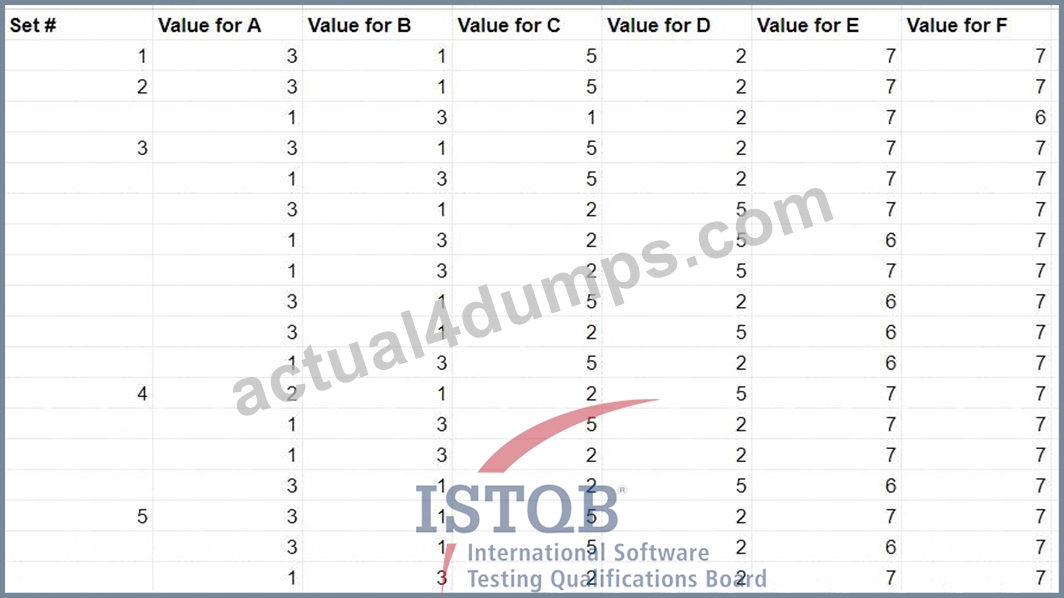
- A. Set 5
- B. Set 1
- C. Set 3
- D. Set 2
Answer: B
Explanation:
In software testing, especially within contexts like nuclear power plants, achieving a "highly recommended" level of coverage often requires strategic test case selection to verify all logical conditions are accurately assessed. For the condition "If ((A > B) or (C > D)) and (E = F) then print A", the critical tests involve evaluating the boolean logic.
* Test Case Analysis: Test Set 1 is selected because it should ideally include scenarios where:
* Both conditions (A > B) and (C > D) are true, and (E = F) is true to ensure the print statement executes.
* One of the conditions (A > B) or (C > D) is false while the other is true, combined with (E = F) being true, to test the OR logic.
* Both conditions (A > B) and (C > D) are false with (E = F) being true, which should not trigger the print statement, testing the AND logic.
* Condition where (E != F), irrespective of other conditions, to confirm that the print statement does not execute.
NEW QUESTION # 40
A new Payroll system calculates the amount of tax that each employee must pay (TaxToPay) on their gross monthly salary (in (), and the net salary (NetSal) that they will receive after that amount of tax has been deducted It also calculates the amounts of tax (TaxPdYTD) and net salary (SalPdYTD) paid in the year to date (YTD) by adding them to the stored amounts from last month (for month 1 these will be zero), inputs Include Employee id (Empid) and Gross Salary this month (GrossSal). Tax Rate is looked up on the key of Employee Id, the amounts of tax and net salary paid in the year to date are looked up on the key of (Employee Id and
[month * 1]) except that for month 1 they will be zero.
if both employees were paid the same in month 1 as in the current month 2. for which tax has now to be calculated, which data-driven input and expected output table is correct for this situation?
Table 1
MonthEmpidGrossSalTaxRateTaxToPayNetSalTaxPdYTD
212000153001700600
222200204401760880
Table 2
MonthEmpidGrossSalTaxRateTaxToPayNetSalSalPdYTD
2120000.153001700600
2222000.24401760880
Table 3
MonthEmpidGrossSalTaxToPayNetSalTaxPdYTDSalPdYTD
11200030017006003400
12220044017608803520
Table 4
MonthEmpidGrossSalTaxToPayNetSalTaxPdYTDSalPdYTD
21200030017006003400
22220044017608803520
SELECT ONE OPTION
- A. Table 2
- B. Table 3
- C. Table 4
- D. Table 1
Answer: A
Explanation:
Table 2 correctly represents the calculation of tax to pay and net salary for employees of a Payroll system, including accurate representation of tax rates as percentages (not whole numbers), and the correct year-to-date accumulation of salary paid, which aligns with the payroll system's operations as described. It accounts for the logical incrementation of cumulative figures and uses percentage representations for tax rates, which is a standard approach in payroll calculations .
NEW QUESTION # 41
Which statement correctly describes service virtualization''
SELECT ONE OPTION
- A. It is a shareable testing service that simulates the behavior, data and performance of a system or service to which the product or component under test would normally be connected
- B. it is a collection of mock objects such as stubs and drivers that will allow a product or component to run without some other product or component that it would normally need
- C. it is an integrated set of tools that will automatically compile, test and deliver into a virtual environment a new build of the product under test
- D. It is a service which automatically deploys new versions of the software into the production environment at regular and short intervals
Answer: A
Explanation:
Service virtualization is used in test environments to simulate the behaviors, data, and performance characteristics of dependent systems that are not available for testing due to limitations such as cost, access, or complexity. This allows for more thorough testing of the product under test in a controlled, stable environment that mimics real-world conditions without the need for actual live systems .
NEW QUESTION # 42
You have been assigned to perform a review on code provided below: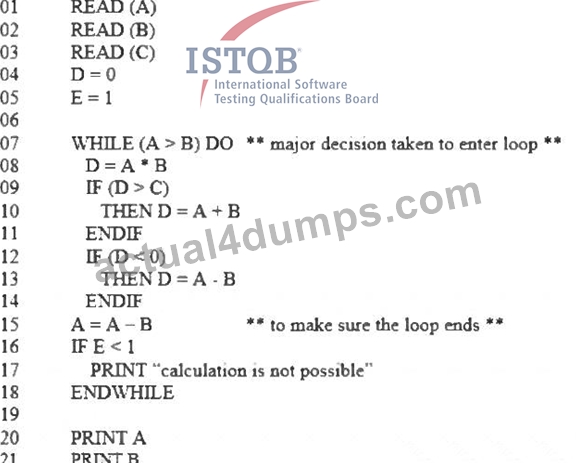
Which type of defect should you report as part of the code review?
- A. No defects should be reported, code is correct.
- B. Unreachable code
- C. Too many nested levels
- D. Endless loop
Answer: D
Explanation:
The code provided contains a potential endless loop. The loop is conditioned on the variable 'E' being less than
1 (IF E < 1), but within the loop, there is no operation that modifies the value of 'E'. Therefore, once the loop is entered, if the condition A > B holds true, the value of 'E' remains unchanged, leading to an endless loop situation. The decrement of 'A' in line 15 does not guarantee an exit condition for the loop, as it does not affect the value of 'E'. This is a control flow defect that could cause the program to hang or crash.
NEW QUESTION # 43
Consider the pseudo code for the Answer program:
Which of the following statements about the Answer program BEST describes the control flow anomalies to be found in the program?
- A. The Answer program contains unreachable code.
- B. The Answer program contains an infinite loop.
- C. The Answer program contains no control flow anomalies.
- D. The Answer program contains unreachable code and an infinite loop.
Answer: D
Explanation:
The provided pseudo code for the Answer program shows a WHILE loop that will always execute because the condition for the loop to terminate (a >= d) is never met within the loop's body. This results in an infinite loop.
Additionally, since the value of 'b' is initialized with 'a + 10' and 'a' starts from a value that is read and then set to 2, 'b' will never be equal to 12. Therefore, the 'THEN' branch of the IF statement, which includes 'print(b)', is unreachable. These are control flow anomalies because they represent logic in the code that will not function as presumably intended.
NEW QUESTION # 44
You are part of an agile team creating a user story.
Which of the following requirements engineering techniques would you use to provide a visual representation of the system and help to see the 'overall* story with the functional flow?
SELECT ONE OPTION
- A. Personas
- B. Story Mapping
- C. Storyboards
- D. Use Cases
Answer: B
Explanation:
Story Mapping is an effective requirements engineering technique used in Agile environments to provide a visual representation of the system. It helps in understanding the 'overall' story and functional flow by mapping user stories along a timeline or process steps, laying them out in a two-dimensional structure that represents the product backlog. This technique is particularly useful for visualizing the scope of large features or entire systems, making it easier to plan releases and improve understanding among the team .
NEW QUESTION # 45
Consider the pseudo code for the Price program: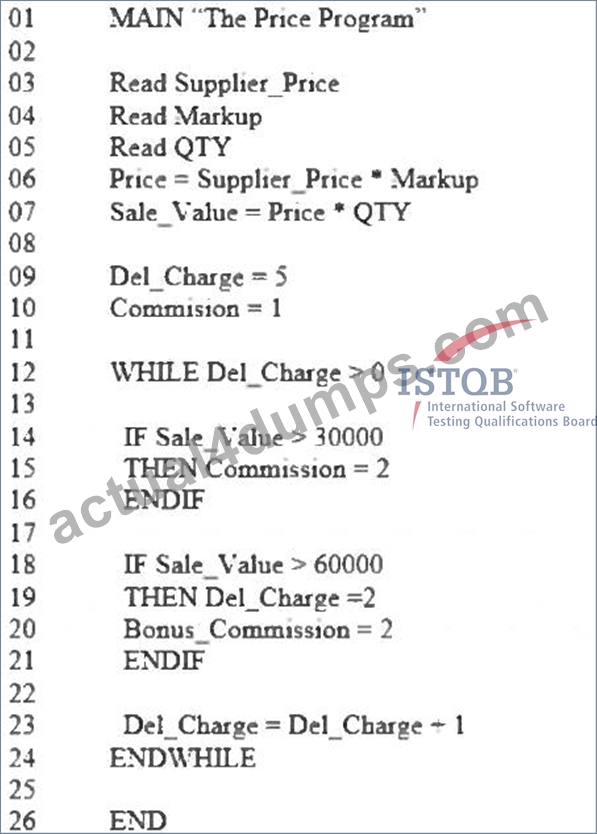
Which of the following statements about the Price program describes a control flow anomaly to be found in the program?
- A. The Price program contains an infinite loop.
- B. The Price program contains no control flow anomalies.
- C. The Price program contains unreachable code.
- D. The Price program contains data flow defects.
Answer: A
Explanation:
The pseudo code provided for the Price program shows a potential for an infinite loop due to the way the
'Del_Charge' variable is being manipulated. The loop is set to continue 'WHILE Del_Charge > 0', and within the loop, 'Del_Charge' is initially set to 5 and then potentially decreased by 2 if 'Sale_Value > 60000'.
However, at the end of each loop iteration, 'Del_Charge' is increased by 1. This means that if 'Sale_Value' is not greater than 60000, 'Del_Charge' will not decrease and will instead increment indefinitely, causing an infinite loop. Even if 'Sale_Value' is greater than 60000, the decrement by 2 could be negated by the subsequent increments if the loop runs enough times, potentially leading to an infinite loop situation. There is no guaranteed exit condition once the loop is entered, which is a control flow anomaly.
NEW QUESTION # 46
Which statement about test automation is TRUE?
SELECT ONE OPTION
- A. The number of test cases in the test suite increases by default from one iteration to another
- B. Test development time should not consider changes to the test environments)
- C. Staff availability should not be allowed to constrain automated deployment
- D. Test suite coverage can be increased without the need for refactoring
Answer: D
Explanation:
The statement "Test suite coverage can be increased without the need for refactoring" is accurate because test suite coverage refers to the extent to which the test cases cover the software under test. This coverage can be enhanced by adding new tests that address areas not previously covered, without necessarily modifying the existing test structures or setups. Refactoring is often related to improving the internal design of the tests for better maintainability or performance but does not inherently affect the coverage directly .
NEW QUESTION # 47
Subject to testing is a software system (COTS) for Project Administration and Control (PACS). PACS is a multi-project system for controlling the project time, e.g., in terms of scheduling and tracking, and managing the productivity of projects, e.g., in terms of effort and deliverables.
During various interviews with stakeholders the following information was gathered:
* Using PACS is not business critical. There is no impact such as high financial losses or problems to the operational continuity of an organization. Its application is not critical since the software package does not support directly the operational, or the primary, business processes of an organization. It supports (project) management in the project planning and tracking process. Of course, it will be highly annoying for users if the system "goes down" from time to time. Although this does not have a high impact for the business process as a whole, the Mean Time Between Failures (MTBF) still needs to be at a good level to be successful in the market.
* Users of PACS typically have an academic educational level, but have no prior experience with this particular type of project management software. The system will be used by a large number of users within an organization.
* The system will be used on a regular basis, e.g., several times per day by project managers and several times per week by project employees. This means that the system will not be used very intensively, often only for some data input or an information request. Its usage is not considered to be very time-critical.
* The data is recorded on-line and real-time. The system is expected to run in multiple hardware environments in various network environments. It is also expected that changes in the operational environments will happen in the upcoming period that also need to be supported.
Based on the information provided by the stakeholder, which combination of non-functional quality characteristics should you propose to test as part of your test approach?
- A. Reliability and Performance efficiency
- B. Reliability and Portability
- C. Security and Reliability
- D. Performance efficiency and Portability
Answer: B
Explanation:
Given the stakeholder information provided:
Reliability is important because the system, while not business-critical, still needs a good MTBF to be successful in the market. This is directly mentioned in the stakeholder information.
Portability is essential as the system is expected to run in multiple hardware environments and various network environments, with changes anticipated in the operational environments.
Security is not highlighted as a concern, and performance efficiency, while generally important, is less critical as the system is not used intensively and is not time-critical. Therefore, reliability and portability are the most relevant non-functional quality characteristics to test in this scenario.
NEW QUESTION # 48
Which of the following is a generic risk factor that should be considered by a Technical Test Analyst during a product risk analysis?
- A. High change rate of business requirements.
- B. Visibility of failure leading to negative publicity and potential image damage.
- C. Complexity of new technology.
- D. Frequency of use of the affected feature by end-users.
Answer: C
Explanation:
A Technical Test Analyst during a product risk analysis would consider the complexity of new technology as a generic risk factor. Complex new technology can introduce uncertainties and potential issues that may not be well-understood, which can increase the risk of defects. Frequency of use, visibility of failure, and high change rate of business requirements are also valid considerations, but they are more specific to particular scenarios or aspects of the product rather than the generic technological complexity which is always a concern regardless of the context.
NEW QUESTION # 49
......
Valid CTAL-TTA Exam Dumps Ensure you a HIGH SCORE: https://www.actual4dumps.com/CTAL-TTA-study-material.html
CTAL-TTA Questions & Practice Test are Available On-Demand: https://drive.google.com/open?id=1dXBUbZNnR3A_fH6jPPWJZDajYLh1LWmM