

Valid 1Z0-082 Exam Dumps Ensure you a HIGH SCORE (2025)
Pass 1Z0-082 Exam with Latest Questions
NEW QUESTION # 10
Which three statements are true about dropping and unused columns in an Oracle database? (Choose three.)
- A. Partition key columns cannot be dropped.
- B. An UNUSED column's space is reclaimed automatically when the block containing that column is next queried.
- C. A column that is set to UNUSED still counts towards the limit of 1000 columns per table
- D. An UNUSED column's space is reclaimed automatically when the row containing that column is next queried.
- E. A primary key column referenced by another column as a foreign key can be dropped if using the CASCADE option.
- F. A DROP COLUMN command can be rolled back
Answer: B,C,E
NEW QUESTION # 11
You want to apply the principle of Least Privilege in all your live databases.
One of your requirements is to revoke unnecessary privileges from all users who have them using Privilege Analysis.
Which three types of analyses can be done using the DBMS_PRIVILEGE_CAPTURE package? (Choose three.)
- A. analysis of all privileges used by all users including administrative users in the database
- B. analysis of privileges granted directly to a role that are then used by a user who has been granted that role
- C. analysis of privileges granted indirectly to a role that are then used by a user who has been granted that role
- D. analysis of privileges that a user has on their own schema objects that they did not use
- E. analysis of all privileges used by all users but excluding administrative users in the database
- F. analysis of privileges that a user has on their own schema objects that they did use
Answer: A,C,D
Explanation:
Explanation/Reference: https://docs.oracle.com/database/121/ARPLS/d_priv_prof.htm#ARPLS74328
NEW QUESTION # 12
Which two statements are true about the results of using the INTERSECT operator in compound queries? (Choose two.)
- A. INTERSECT returns rows common to both sides of the compound query
- B. The number of columns in each SELECT in the compound query can be different
- C. Column names in each SELECT in the compound query can be different
- D. INTERSECT ignores NULLs
- E. Reversing the order of the intersected tables can sometimes affect the output
Answer: A,C
Explanation:
https://www.oracletutorial.com/oracle-basics/oracle-intersect/
NEW QUESTION # 13
In which three situations does a new transaction always start? (Choose three.)
- A. when issuing a DML statement after a DML statement failed in the same session
- B. when issuing a CREATE INDEX statement after a CREATE TABLE statement completed successfully in the same session
- C. when issuing a SELECT FOR UPDATE statement after a CREATE TABLE AS SELECT statement was issued in the same session
- D. when issuing the first Data Manipulation Language (DML) statement after a COMMIT OR ROLLBACK statement was issued in the same session
- E. when issuing a CREATE TABLE statement after a SELECT statement was issued in the same session
- F. when issuing a TRUNCATE statement after a SELECT statement was issued in the same session
Answer: B,C,D
Explanation:
https://docs.oracle.com/en/database/oracle/oracle-database/19/cncpt/transactions.html#GUID-7690181F-8293-47B9-ADC1-905BD9C3AF57
NEW QUESTION # 14
In your data center, Oracle Managed Files (OMF) is used for all databases.
All tablespaces are smallfile tablespaces.
SALES_Q1 is a permanent user-defined tablespace in the SALES database.
Examine this command which is about to be issued by a DBA logged in to the SALES database:
ALTER TABLESPACE sales_q1 ADD DATAFILE;
Which are two actions, either one of which you could take to ensure that the command executes successfully? (Choose two.)
- A. Ensure that DB_RECOVERY_FILE_DEST and DB_CREATE_FILE_DEST each specify locations with at least 50 Mb of available space.
- B. Specify a path in the DATAFILE clause of the command specifying a location with at least 100M of available space.
- C. Ensure that DB_CREATE_FILE_DEST specifies a location with at least 100 Mb of available space.
- D. Ensure that DB_RECOVERY_FILE_DEST and DB_CREATE_FILE_DEST each specify with at least 50 Mb of available space.
- E. Add the AUTOEXTEND ON clause with NEXT set to 100M.
Answer: B,C
NEW QUESTION # 15
Which two statements are true about the Automatic Diagnostic Repository (ADR)? (Choose two.)
- A. It is held inside an Oracle database schema
- B. It supports diagnostics for Automatic Storage Management (ASM)
- C. It supports diagnostics for Oracle Clusterware
- D. The ADR base defaults to $ORACLE_HOME/rdbms/admin ifneither DIAGNOSTIC_DEST nor ORACLE_BASE is set
- E. The ADR base defaults to $ORACLE_HOME/dbs if the DIAGNOSTIC_DEST parameter and the ORACLE_BASE environment variable are not set
Answer: B,C
Explanation:
The database, Oracle Automatic Storage Management (Oracle ASM), the listener, Oracle Clusterware, and other Oracle products or components store all diagnostic data in the ADR. https://docs.oracle.com/database/121/ADMIN/diag.htm#ADMIN11260
NEW QUESTION # 16
Which two tasks can you perform using DBCA for databases? (Choose two.)
- A. Register a new database with an available Enterprise Manager Management server
- B. Configure incremental backups for a new database
- C. Configure a nonstandard block size for a new database
- D. Enable flashback database for an existing database
- E. Change the standard block size of an existing database
Answer: A,E
Explanation:
https://docs.oracle.com/cd/B16254_01/doc/server.102/b14196/install003.htm
NEW QUESTION # 17
Which three statements are true about views in an Oracle database? (Choose three.)
- A. Views can be updated without the need to re-grant privileges on the view
- B. Data Manipulation Language (DML) can always be used on views
- C. Deleting one or more rows using a view whose defining query contains a GROUP BY clause will cause an error
- D. Inserting one or more rows using a view whose defining query contains a GROUP BY clause will cause an error
- E. The WITH CHECK clause prevents certain rows from being displayed when querying the view
- F. The WITH CHECK clause prevents certain rows from being updated or inserted
- G. Tables in the defining query of a view must always exist in order to create the view
Answer: B,D,G
NEW QUESTION # 18
Which three statements are true about roles?
- A. Roles may be granted to roles.
- B. Object privileges may not be granted to roles.
- C. All roles granted to a user are set on by default when the user logs in,
- D. Roles must be password protected.
- E. The SET ROLE statement can enable one or more roles for a session.
- F. The SET ROLE statement can disable one or more roles for a session.
Answer: A,B,F
NEW QUESTION # 19
Which three functions are performed by dispatchers in a shared server configuration? (Choose three.)
- A. receiving inbound requests from processes using shared server connections
- B. sending shared server session responses back to requesters on the appropriate connection
- C. checking for outbound shared server responses on the common outbound response queue
- D. writing inbound request to the common request queue from all shared server connections
- E. sending each connection input request to the appropriate shared server input queue
- F. broadcasting shared server session responses back to requesters on all connections
Answer: A,D,E
NEW QUESTION # 20
Examine these SQL statements which execute successfully: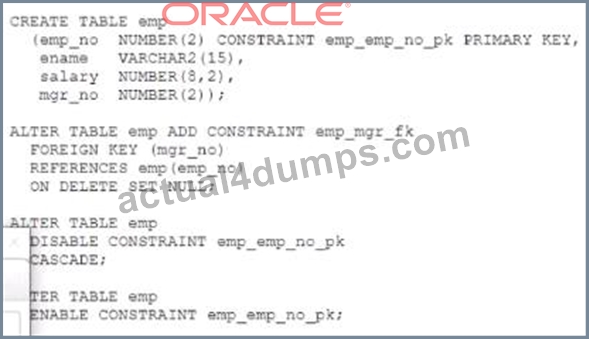
Which two statements are true after execution?
- A. The foreign key constraint will be disabled.
- B. The primary key constraint will be enabled and deferred.
- C. The foreign key constraint will be enabled and deferred.
- D. The foreign key constraint will be enabled and immediate.
- E. The primary key constraint will be enabled and immediate.
Answer: A
NEW QUESTION # 21
Your database instance is started with a PFILE.
Examine these parameters: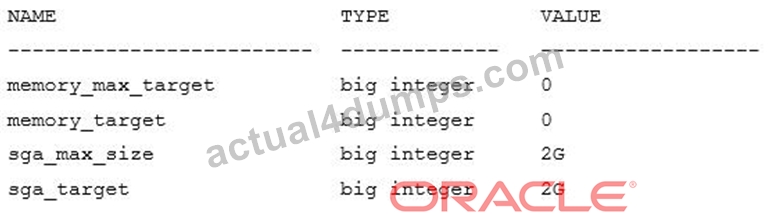
You want to increase the size of the buffer cache.
Free memory is available to increase the size of the buffer cache.
You execute the command:
SQL> ALTER SYSTEM SET DB_CACHE_SIZE=1024M;
What is the outcome?
- A. The value is changed for the current instance and in the PFILE
- B. It fails because the SCOPE clause is missing
- C. Change is applied to the current instance, but does not persist after instance restart
- D. The value is changed only in the PFILE and takes effect at the next instance startup
Answer: C
Explanation:
Reference:
https://docs.oracle.com/database/121/SQLRF/statements_2017.htm#SQLRF00902
NEW QUESTION # 22
Which two are true about RETENTION GUARANTEE? (Choose two.)
- A. It prevents out-of-space errors.
- B. It prevents "Snapshot too old" errors.
- C. It prevents FLASHBACK DATABASE operation failure.
- D. It is a static parameter.
- E. It is a tablespace attribute.
Answer: C,E
NEW QUESTION # 23
The SALES_Q1 and USERS tablespaces exist in one of your databases and TEMP is a temporary tablespace.
Segment creation is not deferred.
You execute this command: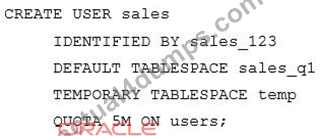
Which three statements must be true so that the SALES user can create tables in SALES_Q1? (Choose three.)
- A. The sales user must have their quota on the users tablespace removed
- B. The sales user must have a quota on the TEMP tablespace
- C. The sales user must have been granted the CREATE TABLE privilege
- D. The sales user must have been granted the CREATE SESSION privilege
- E. The sales user must have a quota on the SALES_Q1 tablespace to hold all the rows to be inserted into any table in their schema
- F. The sales user must have a quota on the SALES_Q1 tablespace to hold the initial extends of all tables they plan to create in their schema
Answer: A,C,F
NEW QUESTION # 24
View the Exhibit and examine the structure of the PRODUCTS table.
Which two tasks require subqueries? (Choose two.)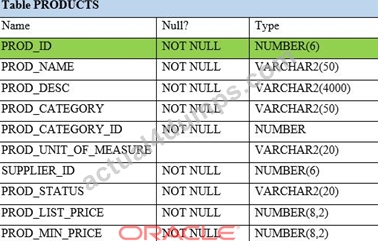
- A. Display the number of products whose PROD_LIST_PRICE is more than the average PROD_LIST_PRICE
- B. Display the minimum PROD_LIST_PRICE for each product status
- C. Display suppliers whose PROD_LIST_PRICE is less than 1000
- D. Display products whose PROD_MIN_PRICE is more than the average PROD_LIST_PRICE of all products, and whose status is orderable
- E. Display the total number of products supplied by supplier 102 which have a product status of obsolete
Answer: A,D
NEW QUESTION # 25
You want to apply the principle of Least Privilege in all your live databases.
One of your requirements is to revoke unnecessary privileges from all users who have them using Privilege Analysis.
Which three types of analyses can be done using the DBMS_PRIVILEGE_CAPTURE package? (Choose three.)
- A. analysis of all privileges used by all users including administrative users in the database
- B. analysis of privileges granted directly to a role that are then used by a user who has been granted that role
- C. analysis of privileges granted indirectly to a role that are then used by a user who has been granted that role
- D. analysis of privileges that a user has on their own schema objects that they did not use
- E. analysis of all privileges used by all users but excluding administrative users in the database
- F. analysis of privileges that a user has on their own schema objects that they did use
Answer: A,C,D
NEW QUESTION # 26
Examine these commands: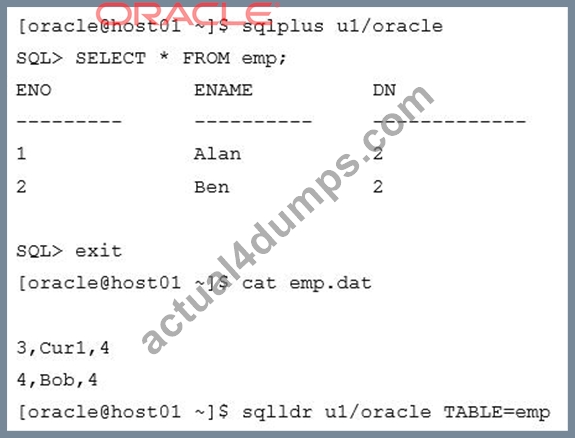
Which two statements are true about the sqlldr execution? (Choose two.)
- A. It overwrites data in EMP with data in EMP.DAT
- B. It uses the database buffer cache to load data
- C. It generates a sql script that it uses to load data from EMP.DAT to EMP
- D. It generates a log that contains control file entries, which can be used with normal SQL*Loader operations
- E. It appends data from EMP.DAT to EMP
Answer: B,C
NEW QUESTION # 27
In which three situations does a new transaction always start? (Choose three.)
- A. when issuing a CREATE INDEX statement after a CREATE TABLE statement completed successfully in the same session
- B. when issuing a SELECT FOR UPDATE statement after a CREATE TABLE AS SELECT statement was issued in the same session
- C. when issuing the first Data Manipulation Language (DML) statement after a COMMIT OR ROLLBACK statement was issued in the same session
- D. when issuing a DML statement after a DML statement failed in the same session
- E. when issuing a CREATE TABLE statement after a SELECT statement was issued in the same session
- F. when issuing a TRUNCATE statement after a SELECT statement was issued in the same session
Answer: B,C,D
NEW QUESTION # 28
You want to apply the principle of Least Privilege in all your live databases.
One of your requirements is to revoke unnecessary privileges from all users who have them using Privilege Analysis.
Which three types of analyses can be done using the DBMS_PRIVILEGE_CAPTURE package? (Choose three.)
- A. analysis of all privileges used by all users including administrative users in the database
- B. analysis of privileges granted indirectly to a role that are then used by a user who has been granted that role
- C. analysis of privileges that a user has on their own schema objects that they did not use
- D. analysis of all privileges used by all users but excluding administrative users in the database
- E. analysis of privileges that a user has on their own schema objects that they did use
- F. analysis of privileges granted directly to a role that are then used by a user who has been granted that role
Answer: B,D,F
Explanation:
https://docs.oracle.com/en/database/oracle/oracle-database/19/dbseg/performing-privilege-analysis-find-privilege-use.html#GUID-AD683DDB-D345-4702-B1F4-37B79F276B66
NEW QUESTION # 29
Examine the description of the CUSTOMERS table: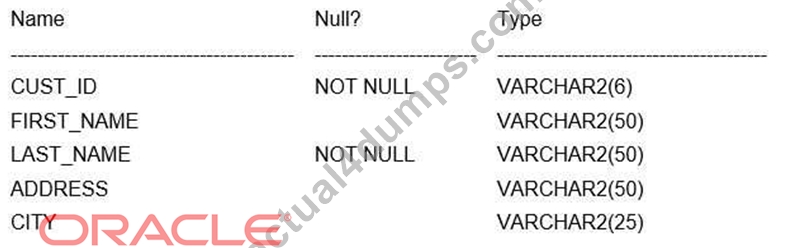
You want to display details of all customers who reside in cities starting with the letter D followed by at least two characters.
Which query can be used?
- A. SELECT * FROM customers WHERE city = '%D_';
- B. SELECT * FROM customers WHERE city LIKE 'D_';
- C. SELECT * FROM customers WHERE city LIKE 'D_%';
- D. SELECT * FROM customers WHERE city = 'D_%';
Answer: C
NEW QUESTION # 30
Which two tasks can you perform using DBCA for databases? (Choose two.)
- A. Register a new database with an available Enterprise Manager Management server
- B. Configure a nonstandard block size for a new database
- C. Configure incremental backups for a new database
- D. Enable flashback database for an existing database
- E. Change the standard block size of an existing database
Answer: A,B
Explanation:
Reference:
https://docs.oracle.com/cd/B16254_01/doc/server.102/b14196/install003.htm
NEW QUESTION # 31
......
Oracle 1Z1-082 exam is an essential certification for anyone who wishes to pursue a career in Oracle Database Administration. 1Z0-082 exam is designed to test the candidate's ability to work with Oracle Database in a real-world environment, and it covers a wide range of topics that are essential for Oracle Database Administration. Obtaining this certification is a valuable asset for anyone who wishes to advance their career in this field.
The Oracle 1Z0-082 exam is designed to test your knowledge of various Oracle concepts, including backup and recovery operations, schema management, data dictionary management, and user management. 1Z0-082 exam is designed to test the practical and theoretical knowledge of the candidate. You should have at least six months of experience in database administration and a solid understanding of database concepts to pass the exam.
1Z0-082 Exam Practice Questions prepared by Oracle Professionals: https://www.actual4dumps.com/1Z0-082-study-material.html
Use Valid New 1Z0-082 Questions - Top choice Help You Gain Success: https://drive.google.com/open?id=18-Z_fc0GRwSMZjRYUnwBZ6uAR_lGFO9J