

Unique Top-selling SPHR Exams - New 2026 HRCI Pratice Exam
HRCI Certifications Dumps SPHR Exam for Full Questions - Exam Study Guide
The Professional in Human Resources (SPHR) certification is a highly esteemed credential for HR professionals that validates their knowledge and expertise in the field. The Professional in Human Resources (SPHR) certification is offered by the Human Resource Certification Institute (HRCI), which is a globally recognized HR certification organization. The SPHR exam measures an individual's ability to design and implement HR programs, policies, and strategies that align with an organization's goals and objectives.
HRCI SPHR, or the Professional in Human Resources certification, is one of the most respected and widely recognized credentials in the HR industry. The Professional in Human Resources (SPHR) certification is designed for HR professionals who have a strategic role in their organization's HR operations. The SPHR certification demonstrates a high level of expertise and knowledge in HR management, including the development of HR strategies, organizational development, talent management, and more.
NEW QUESTION # 29
Which of the following factors can adversely affect transfer of training?
- A. The trainer's expertise
- B. The subject of the training
- C. Training Cost per Employee
- D. A lack of job reinforcement
Answer: D
Explanation:
Answer option B is correct.A lack of job reinforcement can adversely affect transfer of training. Other adverse impacts are the result of interference from the immediate work environment and a nonsupportive organizational climate. The trainer's expertise (A) could affect how well trainees learn information but does not specifically affect transfer of training. The subject of the training (C) affects how receptive trainees are to the information but not necessarily how the information transfers to the job. Chapter: Human Resource Development Objective: Review Questions
NEW QUESTION # 30
Which of the following contains legal provisions for giving compensation to surviving dependents if a work- related injury or illness results in the employee's death?
- A. OSHA
- B. FLSA
- C. BLBA
- D. FECA
Answer: D
Explanation:
Section: Volume A
Explanation/Reference:
Answer option C is correct.
Federal Employees Compensation Act (FECA) is a law that provides rules for compensation benefits to federal employees for work-related injuries or illnesses. FECA contains legal provision for giving compensation to their surviving dependents if a work-related injury or illness results in the employee's death.
Answer option A is incorrect. OSHA stands for Occupational Safety and Health Administration. OSHA is an agency of the United States Department of Labor. It was created by Congress of the United States under the Occupational Safety and Health Act, signed by President Richard
M. Nixon, on December 29, 1970. Its mission is to prevent work-related injuries, illnesses, and occupational fatality by issuing and enforcing standards for workplace safety and health. The agency is headed by a Deputy Assistant Secretary of Labor.
OSHA issues guidelines and regulations for the safe use of a computer.
Answer option B is incorrect. The Black Lung Benefits Act (BLBA) is a law that provides benefits to coal miners who have been disabled by pneumoconiosis as a result of their work in the mines. Benefits are also paid to surviving dependents if the miner dies from the disease.
Answer option D is incorrect. The Fair Labor Standards Act (FLSA) defines a list of jobs not suitable for children between the ages of 16 and 18.
Chapter: Risk Management
Objective: Risk Assessment
NEW QUESTION # 31
An employee has resigned. During the exit interview, the employee tells HR that the reason for the resignation is that for the last 3 months the supervisor has been hostile, refused to provide instructions on work assignments, given the employee all the most unpleasant tasks in the department, and verbally reprimanded the employee in front of co-workers and customers. The employee may have a cause of legal action based on which of the following?
- A. Promissory estoppel
- B. Constructive discharge
- C. Fraudulent misrepresentation
- D. The employer's duty of good faith and fair dealing
Answer: B
Explanation:
Answer option C is correct.Constructive discharge occurs when the employer forces an employee to resign by creating a work environment that is so unpleasant a reasonable person would resign. The duty of good faith and fair dealing (B) applies to contracts, requiring both parties to act in a fair and honest manner with each other to ensure that benefits of the contract are realized. Promissory estoppel (D) occurs when an employer entices an employee to take an action by promising a reward but then does not follow through on the reward. Fraudulent misrepresentation (A) occurs when an employer makes untrue promises or claims to a candidate. Chapter: Employee and Labor Relations Objective: Review Questions
NEW QUESTION # 32
Mary is in an interview with the BAH Company and she asks the company about the stability of the company and its future plans. Tom, the interviewer, assures Mary that the company is solid and has long- term plans for growth and opportunity. Tom, however, knows that the plant and position that Mary is interviewing for will be closed in six months. Tom offers Mary the position of plant manager because he needs someone to manage the facility until they close the plant, but he doesn't tell Mary of his plans. This is an example of which of the following?
- A. Fraudulent misrepresentation
- B. Constructive discharge
- C. Respondeat superior
- D. Defamation
Answer: A
Explanation:
Section: Volume G
Explanation/Reference:
Answer option B is correct.
Tom is committing fraudulent misrepresentation as Mary has asked about the well-being of the company.
Tom knows the plant will be closing and just needs a manager for the plant for the next six months. He hires Mary without telling her this news and implies that the company has a commitment to Mary for a long time.
Answer option C is incorrect. A constructive discharge is a workplace environment which is so hostile that the employee feels obligated to quit.
Answer option D is incorrect. The Latin phrase respondeat superior means "let the master answer." It means the employer can be held liable for the actions of the employee.
Answer option A is incorrect. Defamation happens when an employer or employee tries to defame the reputation of the other during or after a termination process. For example, an employer may give negative references about the terminated employee.
Reference: Professional in Human Resources Certification Guide, Sybex, ISBN: 978-0-470-43096-5.
Chapter 7: Employee and Labor Relations. Official PHR and SPHR Certification Guide, HR Certification Institute, ISBN: 978-1-586-44149-4, Section III, The US Body of Knowledge.
Chapter: Employee and Labor Relations
Objective: Federal Employment Legislation
NEW QUESTION # 33
You are the Senior HR Professional for your organization and you're leading a workshop on HR practices for your department. Your first topic is the Davis Bacon Act. What did the Davis Bacon Act accomplish?
- A. It abolished the requirements for workers to be forced to retire.
- B. It established the minimum retirement age of 65.
- C. It established the minimum working age to be 15.
- D. It was the first legislation to regulate minimum wages.
Answer: D
Explanation:
Explanation/Reference:
Answer option C is correct.
The Davis Bacon Act in 1931 was the first piece of legislation to establish the minimum wage.
Answer options A and D are incorrect. The Davis Bacon Act did not address the retirement age.
Answer option B is incorrect. The Davis Bacon Act did not establish the minimum age to allow people to begin employment.
Reference: Professional in Human Resources Certification Study Guide, Sybex, ISBN: 978-0-470-43096-5.
Chapter Six: Total Rewards. Official PHR and SPHR Certification Guide, HR Certification Institute, ISBN:
978-1-586-44149-4, Section III, The US Body of Knowledge.
Chapter: Compensation and Benefits
Objective: Total Rewards Defined
NEW QUESTION # 34
Before selecting an HRIS system, which of the following questions should be answered?
- A. All of the above.
- B. How will the HRIS be accessed?
- C. What information will be converted to the HRIS?
- D. Who will have access to the information stored in the HRIS?
Answer: A
Explanation:
Section: Volume E
Explanation/Reference:
Answer option C is correct.
A needs analysis will provide answers to these questions, as well as whether the HRIS will be integrated with payroll or other systems and what kinds of reports will be produced. See Chapters 2 and 3 for more information.
Chapter: Core Knowledge Requirements for HR Professionals
Objective: Human Resource Technology
NEW QUESTION # 35
According to Knowles, there are five key assumptions about how adults learn. One of the assumptions is the learner's need to know. Which of the following statements is best associated with the assumption of the learner's need to know?
- A. I understand why I need to learn this.
- B. What I learn today will help me solve problems at my workplace tomorrow.
- C. I'm ready to learn this because what I learn will help me function better in some way.
- D. I've got lots of valuable experience that I want to draw upon to help me as I learn.
Answer: A
Explanation:
Explanation/Reference:
Answer option B is correct.
The statement "I understand why I need to learn this" is an assumption that the learner understands the need to know the course material.
Answer option A is incorrect. The statement "I'm ready to learn this because what I learn will help me function better in some way" is an example of the assumption of the learner's readiness to learn.
Answer option C is incorrect. The statement "What I learn today will help me solve problems at my workplace tomorrow" is an example of the assumption of the learner's orientation to learning.
Answer option D is incorrect. The statement "I've got lots of valuable experience that I want to draw upon to help me as I learn" is an example of the assumption of the learner's experience.
Reference: Professional in Human Resources Certification Guide, Sybex, ISBN: 978-0-470-43096-5.
Chapter 5: Human Resource Development. Official PHR and SPHR Certification Guide, HR Certification Institute, ISBN: 978-1-586-44149-4, Section III, The US Body of Knowledge.
Chapter: Core Knowledge Requirements for HR Professionals
Objective: Adult Learning Processes and Learning Styles
NEW QUESTION # 36
If an employer ignores stress in employees what symptom are employees likely to develop?
- A. Burnout
- B. Tumors
- C. De-motivation
- D. Turnover
Answer: A
Explanation:
Explanation/Reference:
Answer option C is correct.
Burnout is a symptom that can further eradicate performance because of stress in employees. Employers must recognize stress and address the issues caused by stress. Although burnout is work-related, most responsibility for burnout currently rests on the individual worker in the United States, as well as the individual company, as it is in a company's best interest to ensure burnout doesn't occur. The NIOSH outlines an approach in their booklet "Stress at Work."
Answer option D is incorrect. De-motivation may occur, but burnout is the preferred terminology.
Answer option B is incorrect. Approximately 40 percent of turnover is due to stress, but turnover is not necessarily a symptom of an employee.
Answer option A is incorrect. Stress may cause tumors, though there are more complicated health matters that contribute to this symptom. The best answer is burnout.
Reference: PHR Exam prep, Pearson Education, ISBN: 978-0-7897-3677-2. Chapter 8: Risk Management.
Official PHR and SPHR Certification Guide, HR Certification Institute, ISBN: 978-1-586-44149-4, Section III, The US HR Body of Knowledge.
Chapter: Risk Management
Objective: Risk Assessment
NEW QUESTION # 37
As an HR Professional, you must be familiar with certain theories and insights about organizational culture, organizational development, and management. Who addressed organizational culture as "that's the way we do things around here"?
- A. Allen A. Kennedy
- B. Edwards Deming
- C. Frederick Herzberg
- D. Edgard Schein
Answer: D
Explanation:
Section: Volume D
Explanation/Reference:
Answer option A is correct.
Edgard Schein of MIT's Sloan School of Management is the individual who defined organizational culture as
"that's the way we do things around here."
Answer option B is incorrect. Herzberg's Theory of Motivation describes the elements that motivate performance in an individual.
Answer option C is incorrect. Deming is a leader in quality management but didn't address organizational culture, directly.
Answer option D is incorrect. Kennedy is a part of the team Deal and Kennedy who described the four dimensions of organizational culture.
Reference: PHR Exam Prep, Pearson Education, ISBN: 978-0-7897-3677-2. Chapter Seven: Employee and Labor Relations. Official PHR and SPHR Certification Guide, HR Certification Institute, ISBN: 978-1-586-
44149-4, Section III, The US HR Body of Knowledge.
Chapter: Human Resource Development
Objective: Organization Development
NEW QUESTION # 38
Nonexempt employees are not required to be paid to attend training events when four certain conditions are met. Which one of the following is not one of the four conditions to determine if a nonexempt employee should be paid for training?
- A. The event may not be job related
- B. The event must be outside normal work hours
- C. The event must be voluntary
- D. The event's attendance is documented in performance review
Answer: D
Explanation:
Reference: Professional in Human Resources Certification Study Guide, Sybex, ISBN: 9780-470-43096-5. Chapter Six: Total Rewards. Official PHR and SPHR Certification Guide,
HR Certification Institute, ISBN: 978-1-586-44149-4, Section III, The US Body of Knowledge. Chapter: Compensation and Benefits Objective: Total Rewards Defined
NEW QUESTION # 39
Which of the following is a practice of forecasting possible risks to the organization and taking steps to mitigate their impact on operations?
- A. HR audit
- B. Timekeeping
- C. Enterprise risk management
- D. Applicant tracking systems
Answer: C
Explanation:
Section: Volume E
Explanation/Reference:
Answer option D is correct.
Chapter: Business Management and Strategy
Objective: Strategic Management
NEW QUESTION # 40
Part of organizational development is a commitment to quality. What quality control tool is also known as a fishbone diagram?
- A. Ishikawa chart
- B. Pareto chart
- C. Control chart
- D. Histogram chart
Answer: A
Explanation:
Explanation/Reference:
nswer option C is correct.
An Ishikawa chart is also known as a fishbone diagram or a cause-and-effect chart.
The Ishikawa diagram (or fishbone diagram or also cause-and-effect diagram) is a diagram that shows the causes of a certain event. A common use of the Ishikawa diagram is to identify potential factors causing an overall effect. It helps identify causal factors and root causes.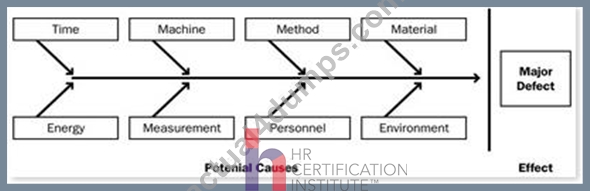
It is known as a fishbone diagram because of its shape, similar to the side view of a fish skeleton. It is considered as a basic tool of quality management.
Answer option B is incorrect. A histogram is simply a bar chart and isn't ordered from largest to smallest.
Answer option D is incorrect. A Pareto chart is a special histogram in that it shows categories of failures from the largest failure to the smallest failure.
Answer option A is incorrect. A control chart shows trend analysis by tracking the results of measurements over time.
"Reference: Professional in Human Resources Certification Guide, Sybex, ISBN: 978-0-470-43096-5.
Chapter 5: Human Resource Development. Official PHR and SPHR Certification Guide, HR Certification Institute, ISBN: 978-1-586-44149-4, Section III, The US Body of Knowledge." Chapter: Human Resource Development
Objective: Organization Development
NEW QUESTION # 41
It's important for an instructor to have clarity of presentation. Which of the following statements is an example of clarity of presentation?
- A. Provide refreshments for the classroom participants.
- B. Adjust the lights for optimal learning.
- C. Use real-world examples for the learning process.
- D. Host the learning session in the morning.
Answer: C
Explanation:
Reference: Professional in Human Resources Certification Guide, Sybex, ISBN: 978-0470-43096-5. Chapter 5: Human Resource Development. Official PHR and SPHR Certification Guide, HR Certification Institute, ISBN: 978-1-586-44149-4, Section III, The US Body of Knowledge.
Chapter: Human Resource Development
Objective: Organization Development
NEW QUESTION # 42
Lucas has asked his manager to take time off from work because of a holiday his religion celebrates. Fran agrees but tells Lucas that he will be inspecting his project work to ensure that the work is accurate and not suffering because of the requested time off. This is an example of what?
- A. Religious persecution in the workforce
- B. Quality control
- C. Disparate treatment
- D. Perpetuating past discrimination
Answer: C
Explanation:
Explanation/Reference:
Answer option C is correct.
Fran should not inspect Lucas' work just because he has asked for time off based on a religious holiday.
Answer option A is incorrect. There's no evidence of past historical discrimination in this example.
Answer option B is incorrect. This isn't a valid answer for the question as any discrimination based on religion falls into disparate discrimination.
Answer option D is incorrect. Quality control does inspect the quality of the work, but it's equal for all project deliverables, not just the deliverables tied to Lucas and his request for time off for the religious holiday.
Reference: PHR Exam Prep, Pearson Education, ISBN: 978-0-7897-3677-2. Chapter Four: Workforce Planning and Employment. Official PHR and SPHR Certification Guide, HR Certification Institute, ISBN:
978-1-586-44149, Section III, The US HR Body of Knowledge.
Chapter: Risk Management
Objective: Risk Assessment
NEW QUESTION # 43
n the concept of the glass ceiling there are three types of barriers that may prevent women and minorities from reaching senior levels of an organization. Which barrier is related to limited educational opportunities?
- A. Cognizant barriers
- B. Governmental barriers
- C. Internal structure barriers
- D. Societal barrier
Answer: D
Explanation:
Explanation/Reference:
Answer option B is correct.
The societal barrier is one of the three barriers of the glass ceiling concept. It addresses limited educational opportunities and biases related to gender, race, and ethnicity.
Answer option C is incorrect. Internal structure barrier is one of the three barriers of the glass ceiling concept. It addresses corporate practices, management control, and recruiting programs.
Answer option D is incorrect. Governmental barrier is one of the three barriers of the glass ceiling concept.
It addresses the inconsistent enforcement of equal opportunity.
Answer option A is incorrect. There is no such barrier as cognizant barrier addressed in the glass ceiling concept.
Reference: Professional in Human Resources Certification Guide, Sybex, ISBN: 978-0-470-43096-5.
Chapter 7: Employee and Labor Relations. Official PHR and SPHR Certification Guide, HR Certification Institute, ISBN: 978-1-586-44149-4, Section III, The US Body of Knowledge.
Chapter: Employee and Labor Relations
Objective: Federal Employment Legislation
NEW QUESTION # 44
Each collective bargaining agreement outlines the process to file a grievance. Most agreements define a four-step approach to the grievance procedure. During which one of the following steps of the grievance procedure, might the president of the local union meet with the manager of the plant at which the employee with the grievance works?
- A. Reach the highest level of internal escalation
- B. Participate in binding arbitration
- C. Initiate the complaint
- D. Escalate the complaint internally
Answer: D
Explanation:
Reference: PHR Exam Prep, Pearson Education, ISBN: 978-0-7897-3677-2. Chapter Seven: Employee and Labor Relations. Official PHR and SPHR Certification Guide, HR Certification Institute, ISBN: 978-1-586-44149-4, Section III, The US HR Body of Knowledge.
Chapter: Business Management and Strategy
Objective: Strategy
NEW QUESTION # 45
As part of your implementation of a new course, you will deliver pilot programs to a small group of learners in your organization. Which of the following are the two types of pilot programs that an organization can use within ADDIE?
- A. Job-sampling program and abbreviated program format
- B. Mock program and management-driven format
- C. Identical program format and abbreviated program format
- D. Instructor-to-instructor format and instructor-to-peer format
Answer: C
Explanation:
Explanation/Reference:
Answer option C is correct.
There are two generally accepted approaches to hosting pilot training: Identical program format and abbreviated program format.
Answer option A is incorrect. These are not valid types of program formats. The two that are used with ADDIE implementation are identical program format and abbreviated program format.
Answer option B is incorrect. These are not valid types of program formats. The two that are used with ADDIE implementation are identical program format and abbreviated program format.
Answer option D is incorrect. These are not valid types of program formats. The two that are used with ADDIE implementation are identical program format and abbreviated program format.
Reference: Professional in Human Resources Certification Guide, Sybex, ISBN: 978-0-470-43096-5.
Chapter 5: Human Resource Development. Official PHR and SPHR Certification Guide, HR Certification Institute, ISBN: 978-1-586-44149-4, Section III, The US Body of Knowledge.
Chapter: Human Resource Development
Objective: Talent Management
NEW QUESTION # 46
Ned is an HR professional for his organization and he's analyzing how employees complete certain tasks on the assembly line. There have been some complaints and claims over the past few months of repetitive stress injuries and cumulative trauma injuries to employees on the assembly line. Ned is examining how the work is completed and looking for unnatural body movements by the workers. What is Ned actually studying?
- A. Job shadowing
- B. OSHA compliance
- C. Mitigation
- D. Ergonomics
Answer: D
Explanation:
Explanation/Reference:
Answer option B is correct.
Ned is studying the ergonomics of the assembly line to gain insight into the injuries, work, and possible mitigation of the unnatural movements.
Answer option C is incorrect. While Ned does want to comply with OSHA, the best answer is ergonomics.
Answer option A is incorrect. This may seem like job shadowing, but Ned isn't looking to learn the process of how to do the work, as is the case in job shadowing, but he's learning about the process of the work as it may relate to repetitive stress injuries and cumulative trauma injuries.
Answer option D is incorrect. Mitigation is the risk response to reduce or lower the probability of the risk event. Ned haven't made any recommendations yet for the risk events.
Reference: Professional in Human Resources Certification Guide, Sybex, ISBN: 978-0-470-43096-5.
Chapter 5: Human Resource Development. Official PHR and SPHR Certification Guide, HR Certification Institute, ISBN: 978-1-586-44149-4, Section III, The US Body of Knowledge.
Chapter: Risk Management
Objective: Risk Assessment
NEW QUESTION # 47
Pauline is a HR Professional for her organization and she's meeting with the sales manager Jim. Jim wants to know if Randy, one of his sales people, is considered exempt or not because he's doing outside sales. Pauline tells Jim that there are just two qualifiers for Randy to be considered exempt in his role as an outside salesperson. The first is that Randy's primary duty must be making sales. What is the other consideration?
- A. Randy must be customarily engaged away from the employer's place of business.
- B. Randy must not have a contract to complete sales.
- C. Randy must earn more than $48,234 per year.
- D. Randy must earn all income from commission.
Answer: A
Explanation:
Explanation/Reference:
Answer option C is correct.
Randy must primarily do sales outside of the employer's place of business to be considered an exempt employee.
Answer option A is incorrect. The amount Randy earns doesn't directly affect his role as an exempt sales person.
Answer option D is incorrect. Randy doesn't have to earn all of his income from commission.
Answer option B is incorrect. Randy doesn't need a contract to do sales.
Reference: PHR Exam Prep, Pearson Education, ISBN: 978-0-7897-3677-2. Chapter Six: Total Rewards.
Official PHR and SPHR Certification Guide, HR Certification Institute, ISBN: 978-1-586-44149-4, Section III, The US HR Body of Knowledge.
Chapter: Core Knowledge Requirements for HR Professionals
Objective: Employee Records Management
NEW QUESTION # 48
Which of the following keeps data current by dropping the oldest data when new data is added?
- A. Moving average
- B. Median
- C. Mean
- D. Mode
Answer: A
Explanation:
Explanation/Reference:
Answer option A is correct.
Chapter: Core Knowledge Requirements for HR Professionals
Objective: Qualitative and Quantitative Analysis
NEW QUESTION # 49
A business professional must plan on the direction and mission of the organization. Questions that direct the business ask where is the business now, where does the business want to go, how will the business get there, and how will we know when it has arrived. What term is assigned to this business introspection?
- A. Planning
- B. Vision
- C. Strategic planning
- D. Mission building
Answer: C
Explanation:
Reference: Professional in Human Resources Certification Study Guide, Sybex, ISBN: 9780-470-43096-5. Chapter Four: Workforce Planning and Employment. Official PHR and SPHR Certification Guide, HR Certification Institute, ISBN: 978-1-586-44149-4, Section III, The US Body of Knowledge.
Chapter: Business Management and Strategy
Objective: Strategy
NEW QUESTION # 50
Which of the following ensures that employees working in different locations are paid at rates competitive in the labor market for specific jobs and locations?
- A. Hazard pay
- B. Call-back pay
- C. Base pay
- D. Geographic pay
Answer: D
Explanation:
Answer option A is correct.
Chapter: Compensation and Benefits
Objective: Compensation
NEW QUESTION # 51
......
To be eligible to take the SPHR exam, candidates must meet specific criteria, including a minimum of four years of experience in a professional-level HR position and a master's degree or higher, or a minimum of seven years of experience in a professional-level HR position without a higher degree. Once candidates have met the eligibility criteria, they can register for the exam and begin preparing for the test.
Best way to practice test for HRCI SPHR: https://www.actual4dumps.com/SPHR-study-material.html
SPHR Dump Ready - Exam Questions and Answers: https://drive.google.com/open?id=1YNCBhaBf6r0mkqgYKSKMkXn3hbsVKdAn