

Share Latest Sep-2025 SPLK-1005Test Practice Test Questions, Exam Dumps
Positive Aspects of Valid Dumps SPLK-1005 Exam Dumps!
Splunk SPLK-1005 exam is a certification exam designed for professionals who are interested in validating their knowledge and skills in managing and administering Splunk Cloud. Splunk Cloud is a powerful cloud-based platform that helps organizations collect, analyze, and visualize machine-generated data in real-time. The SPLK-1005 exam is a challenging certification exam that requires candidates to demonstrate their expertise in various aspects of Splunk Cloud administration.
To pass the SPLK-1005 exam, candidates must demonstrate their knowledge of Splunk Cloud architecture, deployment, and management. They must also show their ability to configure and manage data inputs, indexes, and search heads. In addition, the exam tests candidates on their skills in managing users and roles, configuring alerts and reports, and troubleshooting issues in Splunk Cloud. The SPLK-1005 certification is ideal for IT professionals, system administrators, and security analysts who want to advance their career in the field of data analysis and management. It is also a valuable credential for organizations that use Splunk Cloud and want to validate the skills of their staff in managing and administering the platform.
NEW QUESTION # 49
What is the name of the dashboard that provides information on incoming data consumption and indexing rate for your Splunk Cloud Platform deployment?
- A. Indexing Overview
- B. Indexing Status
- C. Indexing Quality
- D. Indexing Performance
Answer: D
NEW QUESTION # 50
In Splunk terminology, what is an index?
- A. A data repository that contains raw, compressed data along with psidx files.
- B. A data repository that contains raw, uncompressed data along with psidx files.
- C. A data repository that contains raw, uncompressed data along with tsidx files.
- D. A data repository that contains raw, compressed data along with tsidx files.
Answer: D
Explanation:
In Splunk, an index is a data repository that stores both raw data and associated indexing information.
Specifically, the raw data is stored in a compressed format, and the indexing information is stored in tsidx files (time series index files). These tsidx files enable fast searching and retrieval of data based on time. The correct terminology and structure make option B accurate.
Splunk Documentation Reference: Splunk Indexes
NEW QUESTION # 51
Which of the following are features of a managed Splunk Cloud environment?
- A. Availability of premium apps, no IP address whitelisting or blacklisting, deployed in US East AWS region.
- B. Availability of premium apps, SSO integration, maximum concurrent search limit of 20.
- C. 20GB daily maximum data ingestion, no SSO integration, no availability of premium apps.
- D. Availability of premium apps, SSO integration, IP address whitelisting and blacklisting.
Answer: D
Explanation:
In a managed Splunk Cloud environment, several features are available to ensure that the platform is secure, scalable, and meets enterprise requirements. The key features include:
* Availability of premium apps:Splunk Cloud supports the installation and use of premium apps such as Splunk Enterprise Security, IT Service Intelligence, etc.
* SSO Integration:Single Sign-On (SSO) integration is supported, allowing organizations to leverage their existing identity providers for authentication.
* IP address whitelisting and blacklisting:To enhance security, managed Splunk Cloud environments allow for IP address whitelisting and blacklisting to control access.
Given the options:
* Option Ccorrectly lists these features, making it the accurate choice.
* Option Aincorrectly states "no IP address whitelisting or blacklisting," which is indeed available.
* Option Bmentions "no SSO integration" and "no availability of premium apps," both of which are inaccurate.
* Option Dtalks about a "maximum concurrent search limit of 20," which does not represent the standard limit settings and may vary based on the subscription level.
Splunk Documentation References:
* Splunk Cloud Features and Capabilities
* Single Sign-On (SSO) in Splunk Cloud
* Security and Access Control in Splunk Cloud
NEW QUESTION # 52
Files from multiple systems are being stored on a centralized log server. The files are organized into directories based on the original server they came from. Which of the following is a recommended approach for correctly setting the host values based on their origin?
- A. Manually create a separate monitor stanza for each host, with the nose = value set.
- B. Use the host segment, setting.
- C. The host value cannot be dynamically set.
- D. Set host = * in the monitor stanza.
Answer: B
Explanation:
The recommended approach for setting the host values based on their origin when files from multiple systems are stored on a centralized log server is to use the host_segment setting. This setting allows you to dynamically set the host value based on a specific segment of the file path, which can be particularly useful when organizing logs from different servers into directories.
Splunk Documentation Reference: Inputs.conf - host_segment
NEW QUESTION # 53
Which type of forwarder is a legacy option that is not recommended for new deployments?
- A. Deployment client
- B. Universal forwarder
- C. Light forwarder
- D. Heavy forwarder
Answer: C
NEW QUESTION # 54
What is the name of the configuration file where you can define data transformations using regular expressions and other attributes?
- A. props.conf
- B. limits.conf
- C. inputs.conf
- D. transforms.conf
Answer: D
NEW QUESTION # 55
What are the four default roles that Splunk Cloud Platform comes with?
- A. admin, power, user, sc_admin
- B. admin, power, user, can_write
- C. admin, power, user, can_delete
- D. admin, power, user, guest
Answer: A
NEW QUESTION # 56
What is the main difference between events indexes and metrics indexes in Splunk Cloud?
- A. Events indexes use a highly structured format to handle event-based log data, while metrics indexes impose minimal structure and can accommodate any kind of data.
- B. Events indexes store data in compressed form, while metrics indexes store data in uncompressed form.
- C. Events indexes store data in uncompressed form, while metrics indexes store data in compressed form.
- D. Events indexes impose minimal structure and can accommodate any kind of data, while metrics indexes use a highly structured format to handle metrics data.
Answer: D
NEW QUESTION # 57
Given the following set of files, which of the monitor stanzas below will result in Splunk monitoring all of the files ending with .log?
Files:
* /var/log/www1/secure.log
* /var/log/www1/access.log
* /var/log/www2/logs/secure.log
* /var/log/www2/access.log
* /var/log/www2/access.log.1
- A. [monitor:///var/log/.../*]
- B. [monitor:///var/log/*/*]
- C. [monitor:///var/log/*/*.log]
- D. [monitor:///var/log/.../*.log]
Answer: D
Explanation:
Explanation: The ellipsis (...) in [monitor:///var/log/.../*.log] allows Splunk to monitor files ending in .log in all nested directories under /var/log/. [Reference: Splunk Docs on monitor stanza syntax]
NEW QUESTION # 58
Due to internal security policies, a Splunk Cloud administrator cannot send data directly to Splunk Cloud from certain data sources. Additional parsing and API-based data sources also need to be sent to Splunk Cloud. What forwarder type should the Splunk Cloud administrator use to satisfy these requirements within their environment?
- A. Universal forwarder as an intermediate forwarder
- B. Heavy forwarder as an intermediate forwarder
- C. Syslog-ng server with a universal forwarder
- D. Light forwarder as an intermediate forwarder
Answer: B
Explanation:
Explanation: A heavy forwarder is appropriate in this scenario because it can perform additional data parsing, filtering, and routing before forwarding data to Splunk Cloud. This is particularly useful for data that requires preprocessing or cannot be sent directly due to security policies. [Reference: Splunk Docs on forwarder types and capabilities]
NEW QUESTION # 59
The following Apache access log is being ingested into Splunk via a monitor input:
How does Splunk determine the time zone for this event?
- A. The time zone indicator in the raw event data.
- B. The value of the TZ attribute in props. cont for the a :ces3_ccwbined sourcetype.
- C. The value of the TZ attribute in props, conf for the my.webserver.example host.
- D. The time zone of the Heavy/Intermediate Forwarder with the monitor input.
Answer: A
Explanation:
In Splunk, when ingesting logs such as an Apache access log, the time zone for each event is typically determined by the time zone indicator present in the raw event data itself. In the log snippet you provided, the time zone is indicated by -0400, which specifies that the event's timestamp is 4 hours behind UTC (Coordinated Universal Time).
Splunk uses this information directly from the event to properly parse the timestamp and apply the correct time zone. This ensures that the event's time is accurately reflected regardless of the time zone in which the Splunk instance or forwarder is located.
Splunk Cloud Reference: For further details, you can review Splunk documentation on timestamp recognition and time zone handling, especially in relation to log files and data ingestion configurations.
Source:
* Splunk Docs: How Splunk software handles timestamps
* Splunk Docs: Configure event timestamp recognition
NEW QUESTION # 60
Which setting in inputs.conf can be used to specify the command to run the script for a scripted input?
- A. exec
- B. command
- C. script
- D. run
Answer: A
NEW QUESTION # 61
Which of the following takes place during the input phase?
- A. Splunk sets the character encoding of the data.
- B. Splunk breaks data into individual lines.
- C. Splunk looks at the contents of the data to apply the correct source.
- D. Splunk annotates data with only 3 metadata keys: host, source, and sourcetype.
Answer: A
Explanation:
During the input phase in Splunk, the system processes incoming data by first setting the character encoding of the data. This step ensures that the data is correctly interpreted by Splunk, allowing it to be parsed and processed properly later in the pipeline. Other options describe actions that occur during later phases, such as parsing and indexing.
Splunk Documentation Reference: How data moves through the data pipeline
NEW QUESTION # 62
Which tool can be used to verify that data is actually being received on the specified port on the indexing server?
- A. tcpdump
- B. traceroute
- C. ping
- D. netstat
Answer: A
NEW QUESTION # 63
For the following data, what would be the correct attribute/value oair to use to successfully extract the correct timestamp from all the events?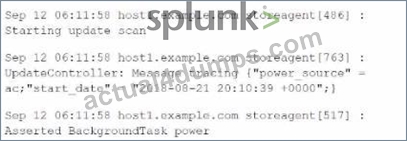
- A. TIME_FORMAT = %b %d %H:%M:%S
- B. TIMK_FORMAT = %b %d %H:%M:%S %z
- C. DATETIKE CONFIG = Sb %d %H:%M:%S
- D. DATETIME CONFIG= %Y-%m-%d %H:%M:%S %2
Answer: A
Explanation:
The correct attribute/value pair to successfully extract the timestamp from the provided events is TIME_FORMAT = %b %d %H:%M:%S. This format corresponds to the structure of the timestamps in the provided data:
* %b represents the abbreviated month name (e.g., Sep).
* %d represents the day of the month.
* %H:%M:%S represents the time in hours, minutes, and seconds.
This format will correctly extract timestamps like "Sep 12 06:11:58".
Splunk Documentation Reference: Configure Timestamp Recognition
NEW QUESTION # 64
What is the name of the tab in Splunk Web where you can set the indexes that a role can access?
- A. Capabilities
- B. Restrictions
- C. Inheritance
- D. Indexes
Answer: D
NEW QUESTION # 65
What is the name of the attribute that you need to set to true in the [search] stanza of the limits.conf file to enable Data Preview?
- A. data_preview_enabled
- B. timeline_events_preview
- C. show_data_preview
- D. enable_data_preview
Answer: B
NEW QUESTION # 66
What is the recommended approach to collect data from network devices?
- A. TCP/UDP Feed > Universal Forwarder > Intermediate Forwarder > Splunk Cloud
- B. TCP/UDP Feed > Intermediate Forwarder > Heavy Forwarder > Splunk Cloud
- C. TCP/UDP Feed > Heavy Forwarder > Intermediate Forwarder > Splunk Cloud
- D. TCP/UDP Feed > Syslog Server with Universal Forwarder > Splunk Cloud
Answer: D
Explanation:
The recommended approach to collect data from network devices is to use a Syslog server with a Universal Forwarder (UF) installed. The network devices send data to the Syslog server, which then forwards the data to Splunk Cloud using the Universal Forwarder. This method ensures reliable data ingestion and processing while maintaining flexibility in handling different types of network device data.
Splunk Documentation Reference: Best practices for getting data in
NEW QUESTION # 67
Windows Input types are collected in Splunk via a script which is configurable using the GUI. What is this type of input called?
- A. Modular
- B. Scripted
- C. Batch
- D. Front-end
Answer: A
Explanation:
Windows inputs in Splunk, particularly those that involve more advanced data collection capabilities beyond simple file monitoring, can utilize scripts or custom inputs. These are typically referred to asModular Inputs.
* C. Modular:This is the correct answer. Modular Inputs are designed to be configurable via the Splunk Web UI and can collect data using custom or predefined scripts, handling more complex data collection tasks. This is the type of input that is used for collecting Windows-specific data such as Event Logs, Performance Monitoring, and other similar inputs.
Splunk Documentation References:
* Modular Inputs
* Windows Data Collection
NEW QUESTION # 68
......
Practice LATEST SPLK-1005 Exam Updated 82 Questions: https://www.actual4dumps.com/SPLK-1005-study-material.html
First Attempt Guaranteed Success in SPLK-1005 Exam: https://drive.google.com/open?id=15Y49-OdBA5FxBG6c5ya5BouIHWDXwPEn