

2025 Valid N10-009 test answers & CompTIA Exam PDF
Free CompTIA N10-009 Exam Questions and Answer from Training Expert Actual4Dumps
NEW QUESTION # 170
A network technician replaced an access layer switch and needs to reconfigure it to allow the connected devices to connect to the correct networks.
INSTRUCTIONS
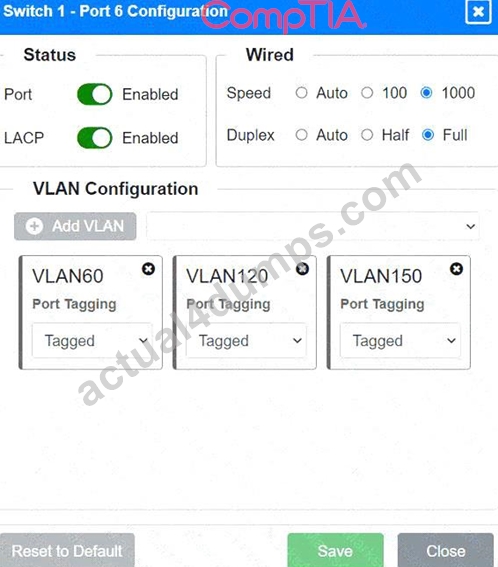
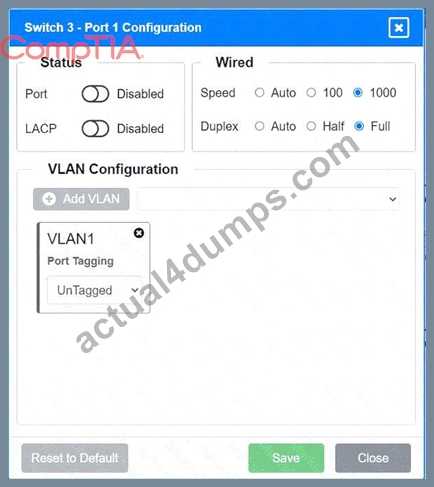
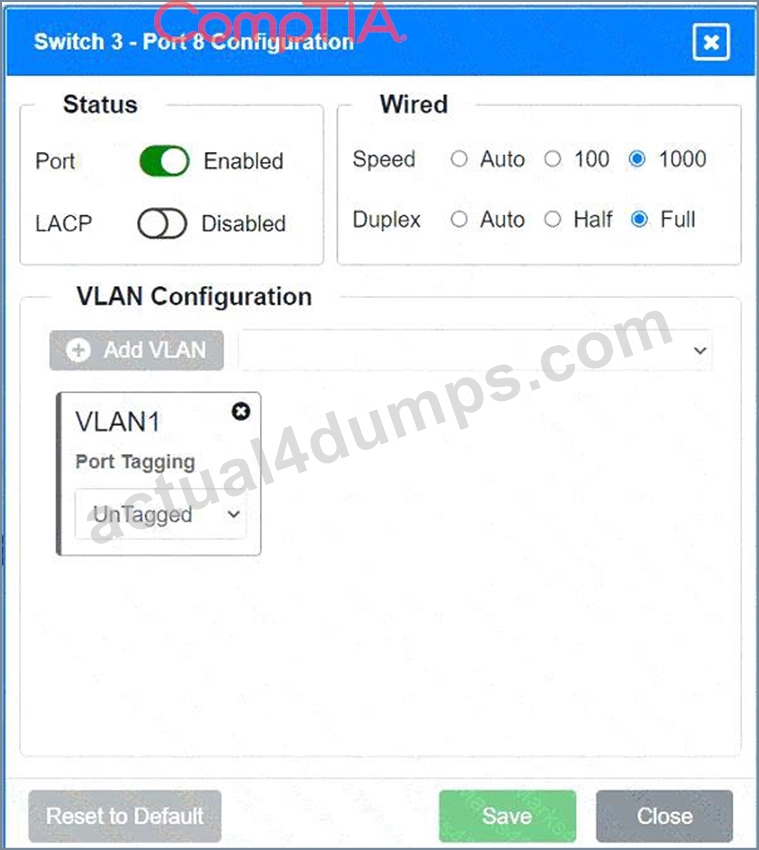
Click on the appropriate port(s) on Switch 1 and Switch 3 to verify or reconfigure the correct settings:
Ensure each device accesses only its
correctly associated network.
Disable all unused switchports.
. Require fault-tolerant connections
between the switches.
. Only make necessary changes to
complete the above requirements.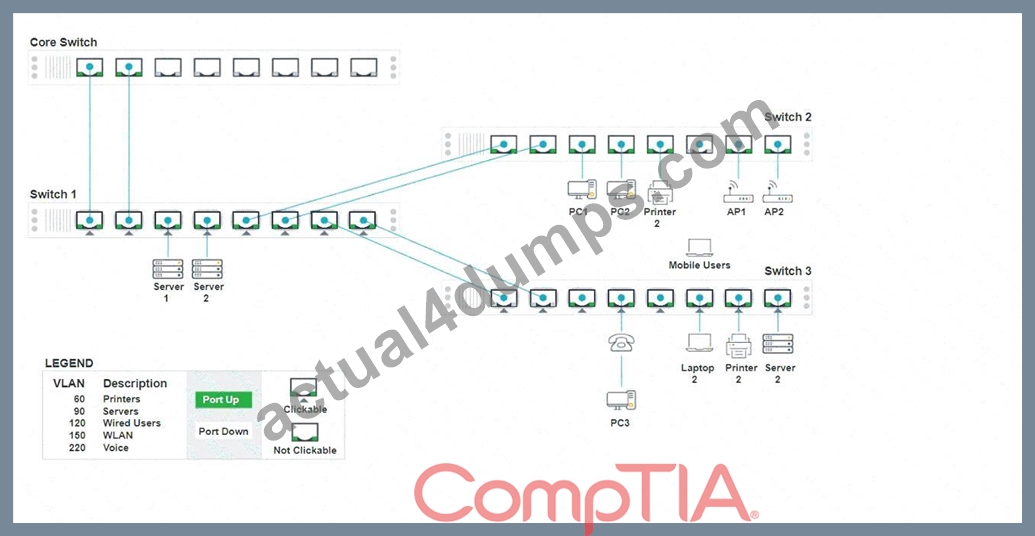
Answer:
Explanation:
See the solution below in Explanation.
Explanation:
To provide a complete solution for configuring the access layer switches, let's proceed with the following steps:
Identify the correct VLANs for each device and port.
Enable necessary ports and disable unused ports.
Configure fault-tolerant connections between the switches.
Port 1 Configuration (Uplink to Core Switch)
Status: Enabled
LACP: Enabled
Speed: 1000
Duplex: Full
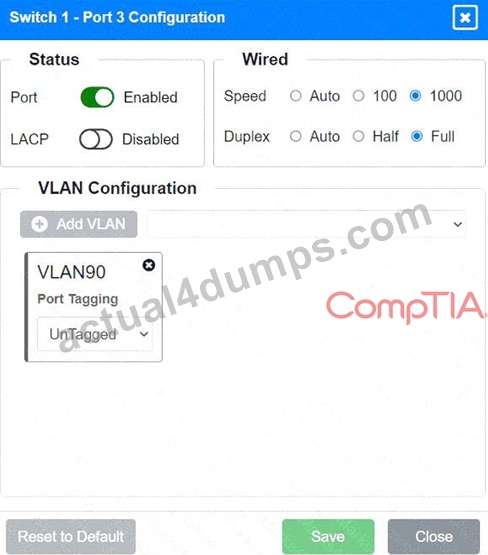
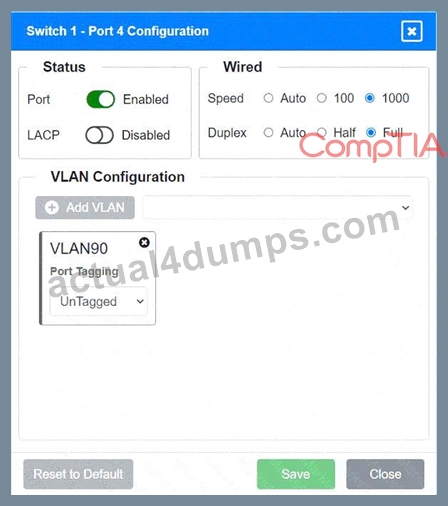
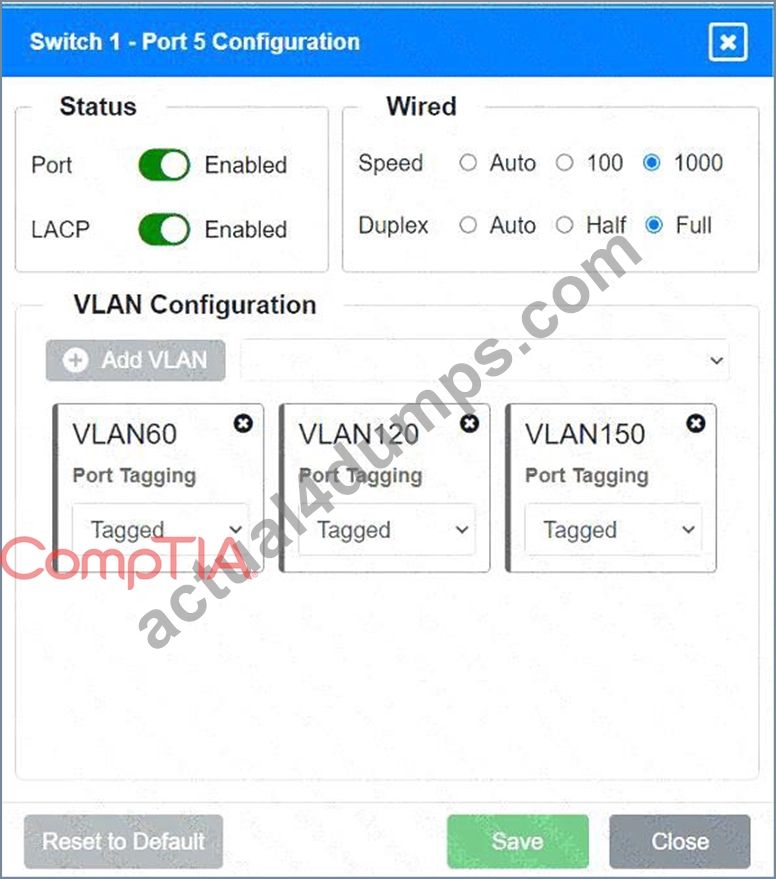
VLAN Configuration: Tagged for VLAN60, VLAN90, VLAN120, VLAN150, VLAN220 Port 2 Configuration (Uplink to Core Switch) Status: Enabled LACP: Enabled Speed: 1000 Duplex: Full VLAN Configuration: Tagged for VLAN60, VLAN90, VLAN120, VLAN150, VLAN220 Port 3 Configuration (Server Connection) Status: Enabled LACP: Disabled Speed: 1000 Duplex: Full VLAN Configuration: Untagged for VLAN90 (Servers) Port 4 Configuration (Server Connection) Status: Enabled LACP: Disabled Speed: 1000 Duplex: Full VLAN Configuration: Untagged for VLAN90 (Servers) Port 5 Configuration (Wired Users and WLAN) Status: Enabled LACP: Enabled Speed: 1000 Duplex: Full VLAN Configuration: Tagged for VLAN60, VLAN120, VLAN150 Port 6 Configuration (Wired Users and WLAN) Status: Enabled LACP: Enabled Speed: 1000 Duplex: Full VLAN Configuration: Tagged for VLAN60, VLAN120, VLAN150 Port 7 Configuration (Voice and Wired Users) Status: Enabled LACP: Enabled Speed: 1000 Duplex: Full VLAN Configuration: Tagged for VLAN60, VLAN90, VLAN120, VLAN220 Port 8 Configuration (Voice, Printers, and Wired Users) Status: Enabled LACP: Enabled Speed: 1000 Duplex: Full VLAN Configuration: Tagged for VLAN60, VLAN90, VLAN120, VLAN220 Port 1 Configuration (Unused) Status: Disabled LACP: Disabled Port 2 Configuration (Unused) Status: Disabled LACP: Disabled Port 3 Configuration (Connection to Device) Status: Enabled LACP: Disabled Speed: 1000 Duplex: Full VLAN Configuration: Untagged for VLAN1 (Default) Port 4 Configuration (Connection to Device) Status: Enabled LACP: Disabled Speed: 1000 Duplex: Full VLAN Configuration: Untagged for VLAN1 (Default) Port 5 Configuration (Connection to Device) Status: Enabled LACP: Disabled Speed: 1000 Duplex: Full VLAN Configuration: Untagged for VLAN1 (Default) Port 6 Configuration (Connection to Device) Status: Enabled LACP: Disabled Speed: 1000 Duplex: Full VLAN Configuration: Untagged for VLAN1 (Default) Port 7 Configuration (Connection to Device) Status: Enabled LACP: Disabled Speed: 1000 Duplex: Full VLAN Configuration: Untagged for VLAN1 (Default) Ports 1 and 2 on Switch 1 are configured as trunk ports with VLAN tagging enabled for all necessary VLANs.
Ports 3 and 4 on Switch 1 are configured for server connections with VLAN 90 untagged.
Ports 5, 6, 7, and 8 on Switch 1 are configured for devices needing access to multiple VLANs.
Unused ports on Switch 3 are disabled.
Ports 3, 4, 5, 6, and 7 on Switch 3 are enabled for default VLAN1.
Core Switch Ports should be configured as needed for uplinks to Switch 1.
Ensure LACP is enabled for redundancy on trunk ports between switches.
By following these configurations, each device will access only its correctly associated network, unused switch ports will be disabled, and fault-tolerant connections will be established between the switches.
NEW QUESTION # 171
Which of the following is the most likely reason an insurance brokerage would enforce VPN usage?
- A. To secure the endpoint
- B. To comply with data retentin requirements
- C. To maintain contractual agreements
- D. To encrypt sensitive data in transit
Answer: D
Explanation:
The most likely reason an insurance brokerage would enforce VPN usage is to encrypt sensitive data in transit. VPNs (Virtual Private Networks) create a secure tunnel between the user's device and the corporate network, ensuring that data is encrypted and protected from interception.
* Encryption: VPNs encrypt data, preventing unauthorized access and ensuring data privacy during transmission over public or unsecured networks.
* Data Protection: Essential for industries handling sensitive information, such as insurance brokerages, to protect customer data and comply with regulatory requirements.
* Security: Enhances overall network security by providing secure remote access for employees.
Network References:
* CompTIA Network+ N10-007 Official Certification Guide: Discusses the role of VPNs in securing data in transit.
* Cisco Networking Academy: Provides training on VPN technologies and their importance in data security.
* Network+ Certification All-in-One Exam Guide: Explains VPN usage and its benefits in protecting sensitive information.
NEW QUESTION # 172
A network administrator needs to set up a multicast network for audio and video broadcasting. Which of the following networks would be the most appropriate for this application?
- A. 240.0.0.0/24
- B. 192.168.0.0/24
- C. 172.16.0.0/24
- D. 224.0.0.0/24
Answer: D
NEW QUESTION # 173
A virtual machine has the following configuration:
*IPv4 address: 169.254.10.10
*Subnet mask: 255.255.0.0
The virtual machine can reach colocated systems but cannot reach external addresses on the Internet. Which of the following Is most likely the root cause?
- A. TheIP address is an RFC1918 private address.
- B. TheDNS server is unreachable.
- C. Thesubnet mask is incorrect.
- D. TheDHCP server is offline.
Answer: D
Explanation:
* Understanding the 169.254.x.x Address:
* An IPv4 address in the range of 169.254.x.x is an Automatic Private IP Addressing (APIPA) address, assigned when a DHCP server is unavailable.
* DHCP Server Offline:
* APIPA Assignment: When a device cannot obtain an IP address from a DHCP server, it assigns itself an APIPA address to enable local network communication. This allows communication with other devices on the same local subnet but not with external networks.
* Resolution: Ensure the DHCP server is operational. Check for connectivity issues between the virtual machine and the DHCP server, and verify the DHCP server settings.
* Comparison with Other Options:
* The subnet mask is incorrect: The subnet mask 255.255.0.0 is appropriate for the 169.254.x.x range and does not prevent external access by itself.
* The IP address is an RFC1918 private address: RFC1918 addresses are private IP ranges (10.x.x.
x, 172.16.x.x-172.31.x.x, 192.168.x.x) but 169.254.x.x is not one of them.
* The DNS server is unreachable: While this could affect name resolution, it would not prevent the assignment of a non-APIPA address or local network communication.
* Troubleshooting Steps:
* Verify the DHCP server's status and connectivity.
* Restart the DHCP service if necessary.
* Renew the IP lease on the virtual machine using commands such as ipconfig /renew (Windows) or dhclient (Linux).
References:
* CompTIA Network+ study materials on IP addressing and DHCP troubleshooting.
NEW QUESTION # 174
Which of the following most likely requires the use of subinterfaces?
- A. A hub utilizing jumbo frames
- B. A router with only one available LAN port
- C. A switch using Spanning Tree Protocol
- D. A firewall performing deep packet inspection
Answer: B
Explanation:
Introduction to Subinterfaces:
Subinterfaces are logical interfaces created on a single physical interface. They are used to enable a router to support multiple networks on a single physical interface.
Use Case for Subinterfaces:
Subinterfaces are commonly used in scenarios where VLANs are implemented. A router with a single physical LAN port can be configured with multiple subinterfaces, each associated with a different VLAN.
This setup allows the router to route traffic between different VLANs.
Example Configuration:
Consider a router with a single physical interface GigabitEthernet0/0 and two VLANs, 10 and 20.
interface GigabitEthernet0/0.10
encapsulation dot1Q 10
ip address 192.168.10.1 255.255.255.0
!
interface GigabitEthernet0/0.20
encapsulation dot1Q 20
ip address 192.168.20.1 255.255.255.0
The encapsulation dot1Q command specifies the VLAN ID.
Explanation of the Options:
A . A router with only one available LAN port: This is correct. Subinterfaces allow a single physical interface to manage multiple networks, making it essential for routers with limited physical interfaces.
B . A firewall performing deep packet inspection: Firewalls can use subinterfaces, but it is not a requirement for deep packet inspection.
C . A hub utilizing jumbo frames: Hubs do not use subinterfaces as they operate at Layer 1 and do not manage IP addressing.
D . A switch using Spanning Tree Protocol: STP is a protocol for preventing loops in a network and does not require subinterfaces.
Conclusion:
Subinterfaces provide a practical solution for routing between multiple VLANs on a router with limited physical interfaces. They allow network administrators to optimize the use of available hardware resources efficiently.
Reference:
CompTIA Network+ guide detailing VLAN configurations and the use of subinterfaces (see page Ref 9 Basic Configuration Commands).
NEW QUESTION # 175
A detective is investigating an identity theft case in which the target had an RFID-protected payment card issued and compromised in the same day. The only place the target claims to have used the card was at a local convenience store. The detective notices a video camera at the store is placed in such a way that customers' credentials can be seen when they pay. Which of the following best explains this social engineering technique?
- A. Vishing
- B. Impersonation
- C. Shoulder surfing
- D. Tailgating
Answer: C
Explanation:
Shoulder surfing is a social engineering attack where attackers observe someone's private information by looking over their shoulder or using tools like cameras to capture input.
From Andrew Ramdayal's guide:
"Shoulder surfing is the act of watching someone enter confidential information, such as PINs or passwords, often using direct line-of-sight or surveillance equipment."
NEW QUESTION # 176
A network administrator changed an external DNS to point customers to a new server. Which of the following tools should the administrator use to test the new server's configuration?
- A. tracert
- B. nslookup
- C. ping
- D. tcpdump
Answer: B
Explanation:
Comprehensive and Detailed Step-by-Step
nslookup allows querying DNS records to verify if the new server is correctly resolving domain names.
ping (A) tests basic connectivity, not DNS configuration.
tracert (B) shows network path latency but doesn't test DNS.
tcpdump (C) captures packets but isn't ideal for DNS verification.
Reference: CompTIA Network+ N10-009 Official Documentation - DNS Testing Tools.
NEW QUESTION # 177
Which of the following is a characteristic of the application layer?
- A. It performs address translation.
- B. It encrypts data in transit.
- C. It relies upon other layers for packet delivery.
OB. It checks independently for packet loss.
Answer: C
Explanation:
Introduction to OSI Model:
The OSI model is a conceptual framework used to understand network interactions in seven layers: Physical, Data Link, Network, Transport, Session, Presentation, and Application.
Application Layer:
The application layer (Layer 7) is the topmost layer in the OSI model. It provides network services directly to end-user applications. This layer facilitates communication between software applications and lower layers of the network protocol stack.
Reliance on Other Layers:
The application layer relies on the transport layer (Layer 4) for data transfer across the network. The transport layer ensures reliable data delivery through protocols like TCP and UDP.
The network layer (Layer 3) is responsible for routing packets to their destination.
The data link layer (Layer 2) handles node-to-node data transfer and error detection.
The physical layer (Layer 1) deals with the physical connection between devices.
Explanation of the Options:
A . It relies upon other layers for packet delivery: This is correct. The application layer depends on the lower layers (transport, network, data link, and physical) for the actual delivery of data packets.
B . It checks independently for packet loss: This is incorrect. Packet loss detection is typically handled by the transport layer (e.g., TCP).
C . It encrypts data in transit: This is incorrect. Encryption is typically handled by the presentation layer or at the transport layer (e.g., TLS/SSL).
D . It performs address translation: This is incorrect. Address translation is performed by the network layer (e.g., NAT).
Conclusion:
The application layer's primary role is to interface with the end-user applications and ensure that data is correctly presented to the user. It relies on the underlying layers to manage the actual data transport and delivery processes.
Reference:
CompTIA Network+ guide covering the OSI model and the specific roles and functions of each layer (see page Ref 10†How to Use Cisco Packet Tracer).
NEW QUESTION # 178
A wireless technician wants to implement a technology that will allow user devices to automatically navigate to the best available frequency standard. Which of the following technologies should the technician use?
- A. Autonomous access point
- B. Directional antenna
- C. Wireless LAN controller
- D. Band steering
Answer: D
Explanation:
Band Steering: This technology enables wireless devices to connect to the most optimal frequency band (2.4 GHz or 5 GHz) by encouraging capable devices to switch to the less congested 5 GHz band. This improves overall network performance and prevents overcrowding on the 2.4 GHz band.
Wireless LAN controller (B): This manages multiple access points in a network but does not handle frequency optimization.
Directional antenna (C): This focuses the signal in a specific direction but does not affect frequency selection.
Autonomous access point (D): This operates independently but lacks advanced features like band steering.
Reference: CompTIA Network+ Official Study Guide, Domain 1.6 (Wireless Standards and Technologies).
NEW QUESTION # 179
An organization wants to ensure that incoming emails were sent from a trusted source. Which of the following DNS records is used to verify the source?
- A. CNAME
- B. TXT
- C. MX
- D. AAAA
Answer: B
Explanation:
A TXT record can be used to store SPF (Sender Policy Framework) and DKIM (DomainKeys Identified Mail) information, which help verify that an email has been sent from a trusted source.
NEW QUESTION # 180
Which of the following is the next step to take after successfully testing a root cause theory?
- A. Duplicate the problem in a lab.
- B. Present the theory for approval.
- C. Determine resolution steps.
- D. Implement the solution to the problem.
Answer: D
Explanation:
Troubleshooting Methodology:
Confirming the Root Cause: After testing and confirming the theory, the next logical step is to address the issue by implementing a solution.
Implementation of the Solution:
Resolve the Issue: Implement the identified solution to rectify the problem. This step involves making necessary changes to the network configuration, replacing faulty hardware, or applying software patches.
Documentation: Document the solution and the steps taken to resolve the issue to provide a reference for future troubleshooting.
Comparison with Other Steps:
Determine Resolution Steps: This is part of the implementation process where specific actions are outlined, but the actual next step after testing is to implement those steps.
Duplicate the Problem in a Lab: This step is typically done earlier in the troubleshooting process to understand the problem, not after confirming the root cause.
Present the Theory for Approval: In some scenarios, presenting the theory might be necessary for major changes, but generally, once the root cause is confirmed, the solution should be implemented.
Final Verification:
After implementing the solution, it is important to verify that the issue is resolved and that normal operations are restored. This may involve monitoring the network and testing to ensure no further issues arise.
Reference:
CompTIA Network+ study materials on troubleshooting methodologies and best practices.
NEW QUESTION # 181
Which of the following routing protocols is most commonly used to interconnect WANs?
- A. IGP
- B. OSPF
- C. EIGRP
- D. BGP
Answer: D
Explanation:
Border Gateway Protocol (BGP): BGP is the most commonly used routing protocol for interconnecting WANs, especially across the internet. It is used for exchanging routing information between autonomous systems (AS), making it the backbone protocol for large-scale WANs.
IGP (A): Interior Gateway Protocols like OSPF and EIGRP are typically used within a single AS, not between them.
EIGRP (B): While it is efficient, EIGRP is primarily used for intra-domain routing and not ideal for WAN interconnection.
OSPF (D): While OSPF can be used for WANs, it is not as common as BGP for inter-AS communication.
NEW QUESTION # 182
Which of the following IP transmission types encrypts all of the transmitted data?
- A. GRE
- B. TC
P - C. ESP
- D. UDP
- E. AH
Answer: C
Explanation:
* Definition of ESP (Encapsulating Security Payload):
* ESP is a part of the IPsec protocol suite used to provide confidentiality, integrity, and authenticity of data. ESP encrypts the payload and optional ESP trailer, providing data confidentiality.
* ESP Functionality:
* ESP can encrypt the entire IP packet, ensuring that the data within the packet is secure from interception or eavesdropping. It also provides options for data integrity and authentication.
* ESP operates in two modes: transport mode (encrypts only the payload of the IP packet) and tunnel mode (encrypts the entire IP packet).
* Comparison with Other Protocols:
* AH (Authentication Header):Provides data integrity and authentication but does not encrypt the payload.
* GRE (Generic Routing Encapsulation):A tunneling protocol that does not provide encryption.
* UDP (User Datagram Protocol) and TCP (Transmission Control Protocol):These are transport layer protocols that do not inherently provide encryption. Encryption must be provided by additional protocols like TLS/SSL.
* Use Cases:
* ESP is widely used in VPNs (Virtual Private Networks) to ensure secure communication over untrusted networks like the internet.
References:
* CompTIA Network+ study materials on IPsec and encryption.
NEW QUESTION # 183
Which of the following disaster recovery metrics is used to describe the amount of data that is lost since the last backup?
- A. RPO
- B. MTTR
- C. RTO
- D. MTBF
Answer: A
Explanation:
* Definition of RPO:
* Recovery Point Objective (RPO)is a disaster recovery metric that describes the maximum acceptable amount of data loss measured in time. It indicates the point in time to which data must
* be recovered to resume normal operations after a disaster.
* For example, if the RPO is set to 24 hours, then the business could tolerate losing up to 24 hours' worth of data in the event of a disruption.
* Why RPO is Important:
* RPO is critical for determining backup frequency and helps businesses decide how often they need to back up their data. A lower RPO means more frequent backups and less potential data loss.
* Comparison with Other Metrics:
* MTTR (Mean Time to Repair):Refers to the average time required to repair a system or component and return it to normal operation.
* RTO (Recovery Time Objective):The maximum acceptable length of time that a computer, system, network, or application can be down after a failure or disaster occurs.
* MTBF (Mean Time Between Failures):The predicted elapsed time between inherent failures of a system during operation.
* How RPO is Used in Disaster Recovery:
* Organizations establish RPOs to ensure that they can recover data within a timeframe that is acceptable to business operations. This involves creating a backup plan that meets the RPO requirements.
References:
* CompTIA Network+ study materials and certification guides.
NEW QUESTION # 184
Which of the following is a characteristic of the application layer?
- A. It performs address translation.
- B. It encrypts data in transit.
- C. It relies upon other layers for packet delivery.
OB. It checks independently for packet loss.
Answer: C
Explanation:
Introduction to OSI Model:
The OSI model is a conceptual framework used to understand network interactions in seven layers: Physical, Data Link, Network, Transport, Session, Presentation, and Application.
Application Layer:
The application layer (Layer 7) is the topmost layer in the OSI model. It provides network services directly to end-user applications. This layer facilitates communication between software applications and lower layers of the network protocol stack.
Reliance on Other Layers:
The application layer relies on the transport layer (Layer 4) for data transfer across the network. The transport layer ensures reliable data delivery through protocols like TCP and UDP.
The network layer (Layer 3) is responsible for routing packets to their destination.
The data link layer (Layer 2) handles node-to-node data transfer and error detection.
The physical layer (Layer 1) deals with the physical connection between devices.
Explanation of the Options:
A . It relies upon other layers for packet delivery: This is correct. The application layer depends on the lower layers (transport, network, data link, and physical) for the actual delivery of data packets.
B . It checks independently for packet loss: This is incorrect. Packet loss detection is typically handled by the transport layer (e.g., TCP).
C . It encrypts data in transit: This is incorrect. Encryption is typically handled by the presentation layer or at the transport layer (e.g., TLS/SSL).
D . It performs address translation: This is incorrect. Address translation is performed by the network layer (e.g., NAT).
Conclusion:
The application layer's primary role is to interface with the end-user applications and ensure that data is correctly presented to the user. It relies on the underlying layers to manage the actual data transport and delivery processes.
Reference:
CompTIA Network+ guide covering the OSI model and the specific roles and functions of each layer (see page Ref 10fHow to Use Cisco Packet Tracer).
NEW QUESTION # 185
A company is hosting a secure that requires all connections to the server to be encrypted. A junior administrator needs to harded the web server. The following ports on the web server. The following ports on the web server are open:
Which of the following ports should be disabled?
- A. 0
- B. 1
- C. 2
- D. 3
Answer: B
Explanation:
For a web server that requires all connections to be encrypted, port 80 (HTTP) should be disabled. Port 80 is used for unencrypted web traffic, whereas port 443 is used for HTTPS, which provides encrypted communication.
Port 80 (HTTP): This port is used for unsecured web traffic. Disabling this port ensures that all web traffic must use HTTPS, which encrypts the data in transit.
Port 443 (HTTPS): This port is used for secure web traffic via SSL/TLS encryption. Keeping this port open ensures that secure connections can be made to the web server.
Other Ports:
Port 22: Used for SSH, providing secure remote access and file transfers.
Port 587: Used for secure email submission (SMTP) with encryption.
Network References:
CompTIA Network+ N10-007 Official Certification Guide: Discusses the roles and security implications of various ports and protocols.
Cisco Networking Academy: Provides training on secure web server configuration and port management.
Network+ Certification All-in-One Exam Guide: Covers port security and best practices for securing web servers.
NEW QUESTION # 186
Which of the following is the greatest advantage of maintaining a cold DR site compared to other DR sites?
- A. Cost
- B. Redundancy
- C. Availability
- D. Security
Answer: A
Explanation:
Acold disaster recovery (DR) siteis a backup facility equipped withminimal infrastructure, often lacking active systems or real-time data replication. Itsgreatest advantage is cost-efficiency. Cold sites aremuch cheaperto maintain than warm or hot sites, which require continuous synchronization and operational readiness. They are used when low cost is more important than recovery speed.
Reference:Section 3.3 - Disaster Recovery Concepts - "Cold, Warm, and Hot Sites Comparison"
NEW QUESTION # 187
Which of the following protocols uses the Dijkstra's Link State Algorithm to establish routes inside its routing table?
- A. BGP
- B. EIGRP
- C. OSPF
- D. RIP
Answer: C
Explanation:
OSPF (Open Shortest Path First) is a link-state routing protocol that uses the Dijkstra algorithm, also known as the shortest path first (SPF) algorithm, to determine the most efficient routes.
From Andrew Ramdayal's guide:
"OSPF is a link-state routing protocol that provides fast, efficient path selection using the shortest path first (SPF) algorithm."
NEW QUESTION # 188
Which of the following is most closely associated with a dedicated link to a cloud environment and may not include encryption?
- A. Captive portal
- B. Direct Connect
- C. VPN
- D. Internet gateway
Answer: B
Explanation:
Direct Connect refers to a dedicated network connection between an on-premises network and a cloud service provider (such as AWS Direct Connect). This link bypasses the public internet, providing a more reliable and higher-bandwidth connection. It may not inherently include encryption because it relies on the security measures of the dedicated physical connection itself. In contrast, other options like VPN typically involve encryption as they traverse the public internet.
NEW QUESTION # 189
......
Top CompTIA N10-009 Courses Online: https://www.actual4dumps.com/N10-009-study-material.html
N10-009 Practice Dumps - Verified By Actual4Dumps Updated 335 Questions: https://drive.google.com/open?id=1_pFG2Gik1S8tIXsdYr96PfDPf43c7LCy