

100-150 Practice Exams and Training Solutions for Certifications
Dumps Free Test Engine Player Verified Answers
Cisco 100-150 Exam Syllabus Topics:
| Topic | Details |
|---|---|
| Topic 1 |
|
| Topic 2 |
|
| Topic 3 |
|
| Topic 4 |
|
| Topic 5 |
|
NEW QUESTION # 49
Which standard contains the specifications for Wi-Fi networks?
- A. IEEE 802.3
- B. IEEE 802.11
- C. GSM
- D. EIA/TIA 568A
- E. LTE
Answer: B
Explanation:
IEEE 802.11 is the standard that defines the protocols and specifications for wireless local area (Wi-Fi) networking.
NEW QUESTION # 50
What is the primary purpose of a firewall in a network security architecture within an organization?
- A. Provide wireless access
- B. Translate domain names
- C. Assign IP addresses
- D. Monitor and filter traffic
Answer: D
Explanation:
A firewall controls incoming and outgoing traffic based on security rules, helping protect networks from unauthorized access and potential cyber threats.
NEW QUESTION # 51
Drag and Drop Question
You need to configure wireless settings for a home router.
Move the actions from the list on the left to the correct scenarios on the right. You may use each action once, more than once, or not at all.
Note: You will receive partial credit for each correct answer.
Answer:
Explanation:
Explanation:
WPA2-PSK requires devices to use a pre-shared key when joining the wireless network.
Disabling SSID broadcasting helps prevent devices from seeing the wireless network name in normal discovery. Disabling WPS prevents users from connecting through the push-button setup method.
NEW QUESTION # 52
A host is given the IP address 172.16.100.25 and the subnet mask 255.255.252.0.
What is the CIDR notation for this address?
- A. 172.16.100.25 /20
- B. 172.16.100.25 /23
- C. 172.16.100.25 /21
- D. 172.16.100.25 /22
Answer: D
Explanation:
The CIDR (Classless Inter-Domain Routing) notation for the subnet mask 255.255.252.0 is /22. This notation indicates that the first 22 bits of the IP address are used for network identification, and the remaining bits are used for host addresses within the network1.
References :=
*Subnet Cheat Sheet - 24 Subnet Mask, 30, 26, 27, 29, and other IP Address CIDR Network References
*Subnet Mask to CIDR Notation: The given subnet mask is 255.255.252.0. To convert this to CIDR notation:
*Convert the subnet mask to binary: 11111111.11111111.11111100.00000000
*Count the number of consecutive 1s in the binary form: There are 22 ones.
*Therefore, the CIDR notation is /22.
References:
*Understanding Subnetting and CIDR: Cisco CIDR Guide
NEW QUESTION # 53
Which component of the AAA service security model provides identity verification?
- A. Accounting
- B. Authentication
- C. Auditing
- D. Authorization
Answer: B
Explanation:
Authentication is the process that verifies a user's or device's identity before granting access.
NEW QUESTION # 54
A support technician examines the front panel of a Cisco switch and sees 4 Ethernet cables connected in the first four ports. Ports 1, 2, and 3 have a green LED. Port 4 has a blinking green light.
What is the state of the Port 4?
- A. Link is up with cable malfunctions.
- B. Link is up and not stable.
- C. Link is up and there is no activity.
- D. Link is up and active.
Answer: D
Explanation:
On a Cisco switch, a port with a blinking green LED typically indicates that the port is up (active) and is currently transmitting or receiving data. This is a normal state indicating active traffic on the port.
*A. Link is up with cable malfunctions: Usually indicated by an amber or blinking amber light.
*B. Link is up and not stable: Not typically indicated by a green blinking light.
*D. Link is up and there is no activity: Would be indicated by a solid green light without blinking.
Thus, the correct answer is C. Link is up and active.
References :=
*Cisco Switch LED Indicators
*Cisco Ethernet Switch LED Patterns
NEW QUESTION # 55
HOTSPOT
You plan to use a network firewall to protect computers at a small office. For each statement about firewalls, select True or False.
Note: You will receive partial credit for each correct selection.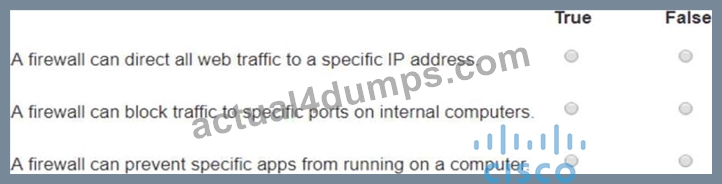
Answer:
Explanation: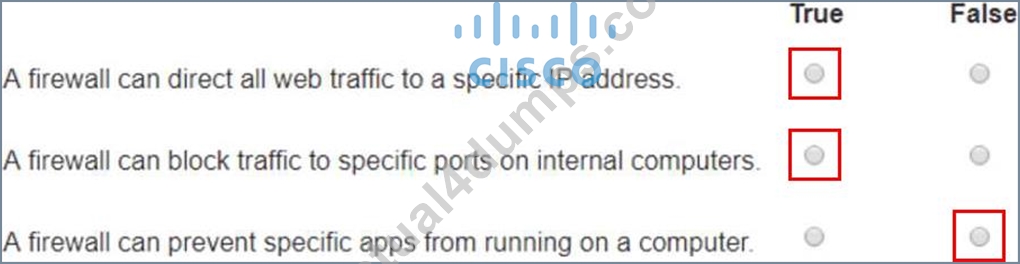
Explanation:
A firewall can direct all web traffic to a specific IP address.
True: Firewalls can be configured to perform Network Address Translation (NAT) and port forwarding, which can direct all web traffic (typically on port 80 and 443) to a specific internal IP address.
A firewall can block traffic to specific ports on internal computers.
True: Firewalls can be configured with access control lists (ACLs) or rules to block traffic to specific ports on internal computers, enhancing security by restricting unwanted or harmful traffic.
A firewall can prevent specific apps from running on a computer.
False: Firewalls typically control traffic flow and do not prevent specific applications from running on a computer. Application control is usually managed by endpoint security software or application control systems.
Directing Web Traffic: Firewalls can manage traffic redirection using NAT and port forwarding rules to route web traffic to designated servers or devices within the network.
Blocking Specific Ports: Firewalls can enforce security policies by blocking or allowing traffic based on port numbers, ensuring that only permitted traffic reaches internal systems.
Application Control: While firewalls manage network traffic, preventing applications from running typically requires software specifically designed for endpoint protection and application
management.
Reference: Understanding Firewalls: Firewall Capabilities
Network Security Best Practices: Network Security Guide
NEW QUESTION # 56
Drag and Drop Question
Move the security options from the list on the left to its characteristic on the right. You may use each security option once, more than once, or not at all.
Note: You will receive partial credit for each correct answer.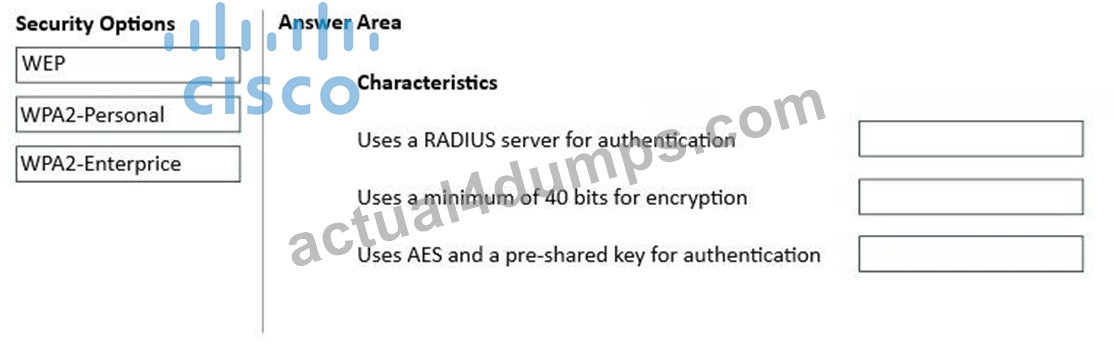
Answer:
Explanation: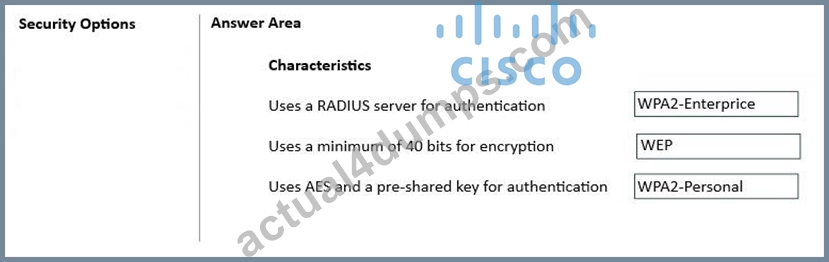
NEW QUESTION # 57
Which protocol is used to automatically assign IP addresses and other network configuration parameters to devices on a network?
- A. DHCP
- B. FTP
- C. SNMP
- D. DNS
Answer: A
Explanation:
DHCP dynamically assigns IP addresses, subnet masks, gateways, and DNS servers, simplifying network management and reducing configuration errors compared to manual IP assignment.
NEW QUESTION # 58
A help desk technician receives the four trouble tickets listed below. Which ticket should receive the highest priority and be addressed first?
- A. Ticket 2: An online webinar is taking place in the conference room. The video conferencing equipment lost internet access.
- B. Ticket 1: A user requests relocation of a printer to a different network jack in the same office. The jack must be patched and made active.
- C. Ticket 3: A user reports that response time for a cloud-based application is slower than usual.
- D. Ticket 4: Two users report that wireless access in the cafeteria has been down for the last hour.
Answer: A
Explanation:
When prioritizing trouble tickets, the most critical issues affecting business operations or high-impact activities should be addressed first. Here's a breakdown of the tickets:
* Ticket 1: Relocation of a printer, while necessary, is not urgent and does not impact critical operations.
* Ticket 2: An ongoing webinar losing internet access is critical, especially if the webinar is time- sensitive and involves multiple participants.
* Ticket 3: Slower response time for a cloud-based application is important but typically not as urgent as a complete loss of internet access for a live event.
* Ticket 4: Wireless access down in the cafeteria affects users but does not have the same immediate impact as a live webinar losing connectivity.
Thus, the correct answer is B. Ticket 2: An online webinar is taking place in the conference room. The video conferencing equipment lost internet access.
References :=
* IT Help Desk Best Practices
* Prioritizing IT Support Tickets
NEW QUESTION # 59
A user reports that a company website is not available. The help desk technician issues a tracertcommand to determine if the server hosting the website is reachable over the network.
The output of the command is shown as follows: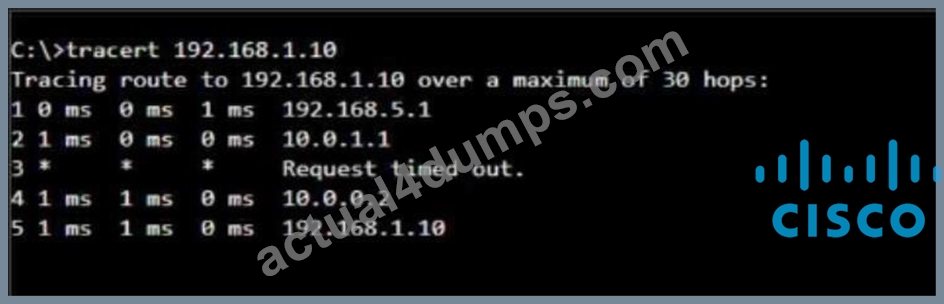
What can you tell from the command output?
- A. The server with the address 192.168.1.10is reachable over the network.
- B. The server address 192.168.1.10is being blocked by a firewall on the router at hop 3.
- C. Requests to the web server at 192.168.1.10are being delayed and time out.
- D. The router at hop 3 is not forwarding packets to the IP address 192.168.1.10.
Answer: A
Explanation:
Despite the timeout at hop 3, the trace reaches 192.168.1.10 at hop 5, indicating the server is reachable over the network.
NEW QUESTION # 60
In the network shown in the following graphic, Switch1 is a Layer 2 switch.
PC-A sends a frame to PC-C. Switch1 does not have a mapping entry for the MAC address of PC-C.
Which action does Switch1 take?
- A. Switch1 queries Switch2 for the MAC address of PC-C.
- B. Switch1 drops the frame and sends an error message back to PC-
- C. Switch1 sends an ARP request to obtain the MAC address of PC-
- D. Switch1 floods the frame out all active ports except port G0/1.
Answer: B
Explanation:
In a network, when a Layer 2 switch (like Switch1) receives a frame destined for a MAC address that is not in its MAC address table, it performs a flooding operation. This means the switch will send the frame out of all ports except the port on which the frame was received. This flooding ensures that if the destination device is connected to one of the other ports, it will receive the frame and respond, allowing the switch to learn its MAC address.
A). Switch1 queries Switch2 for the MAC address of PC-C: This does not happen in Layer 2 switches; they do not query other switches for MAC addresses.
A). Switch1 drops the frame and sends an error message back to PC-A: This is not the default behavior for unknown unicast frames.
D). Switch1 sends an ARP request to obtain the MAC address of PC-C: ARP is used by devices to map IP addresses to MAC addresses, not by switches to find unknown MAC addresses.
Thus, the correct answer is
B). Switch1 floods the frame out all active ports except port G0/1.
Reference: =
Cisco Layer 2 Switching Overview
Switching Mechanisms (Cisco)
NEW QUESTION # 61
Which device protects the network by permitting or denying traffic based on IP address, port number, or application?
- A. Firewall
- B. VPN gateway
- C. Access point
- D. Intrusion detection system
Answer: A
Explanation:
Firewall: A firewall is a network security device that monitors and controls incoming and outgoing network traffic based on predetermined security rules. It permits or denies traffic based on IP addresses, port numbers, or applications.
Access Point: This is a device that allows wireless devices to connect to a wired network using Wi-Fi.
It does not perform traffic filtering based on IP, port, or application.
VPN Gateway: This device allows for secure connections between networks over the internet, but it is not primarily used for traffic filtering based on IP, port, or application.
Intrusion Detection System (IDS): This device monitors network traffic for suspicious activity and policy violations, but it does not actively permit or deny traffic.
Reference: Understanding Firewalls: Firewall Basics
NEW QUESTION # 62
Move each protocol from the list on the left to its correct example on the right.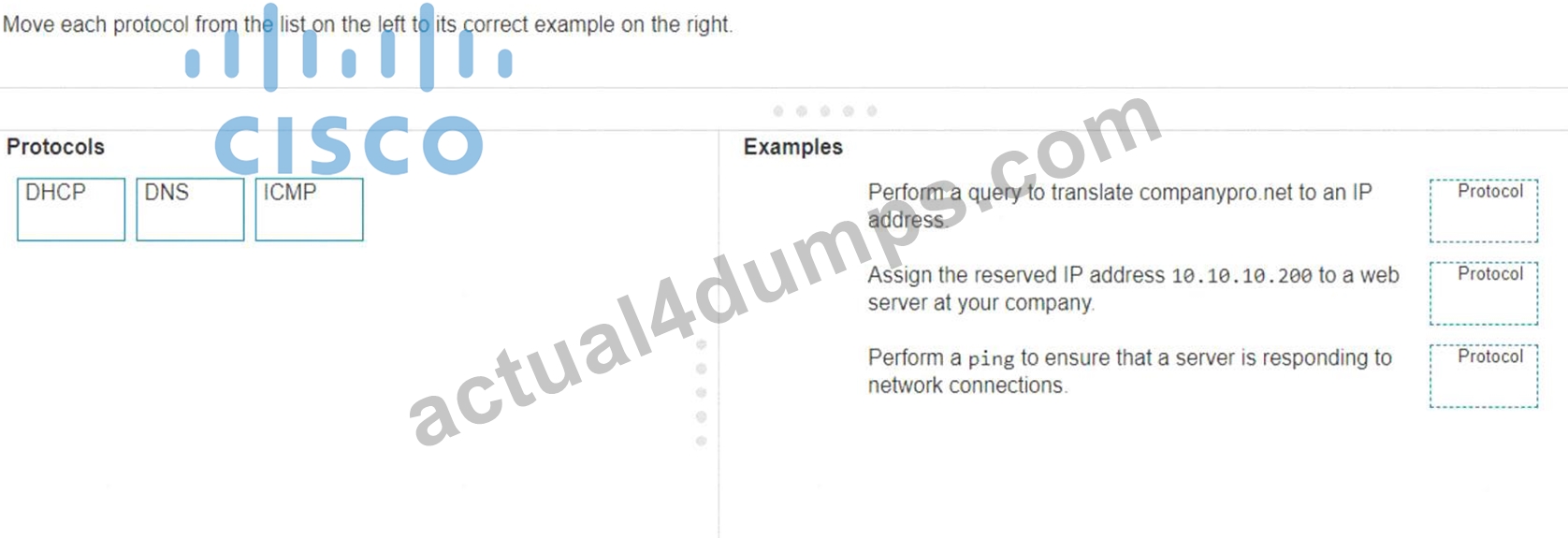
Answer:
Explanation: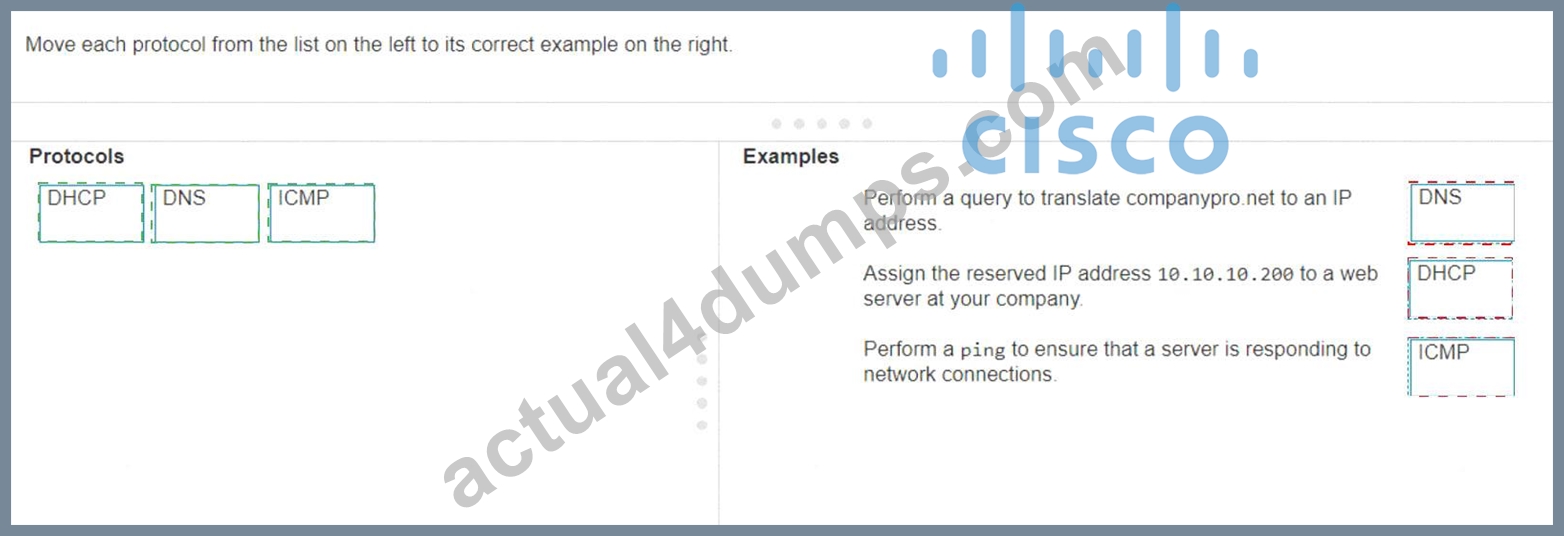
Explanation:
The correct matching of the protocols to their examples is as follows:
* DHCP: Assign the reserved IP address 10.10.10.200 to a web server at your company.
* DNS: Perform a query to translate companypro.net to an IP address.
* ICMP: Perform a ping to ensure that a server is responding to network connections.
Here's how each protocol corresponds to its example:
* DHCP (Dynamic Host Configuration Protocol) is used to assign IP addresses to devices on a network. In this case, DHCP would be used to assign the reserved IP address 10.10.10.200 to a web server.
* DNS (Domain Name System) is used to translate domain names into IP addresses. Therefore, to translate companypro.net to an IP address, DNS would be utilized.
* ICMP (Internet Control Message Protocol) is used for sending error messages and operational information indicating success or failure when communicating with another IP address. An example of this is using the ping command to check if a server is responding to network connections.
These protocols are essential for the smooth operation of networks and the internet.
* Perform a query to translate companypro.net to an IP address.
* DNS (Domain Name System): DNS is used to resolve domain names to IP addresses.
* Assign the reserved IP address 10.10.10.200 to a web server at your company.
* DHCP (Dynamic Host Configuration Protocol): DHCP is used to assign IP addresses to devices on a network.
* Perform a ping to ensure that a server is responding to network connections.
* ICMP (Internet Control Message Protocol): ICMP is used by network devices to send error messages and operational information, and it is the protocol used by the ping command.
* DNS (Domain Name System): DNS translates human-friendly domain names like "companypro.net" into IP addresses that computers use to identify each other on the network.
* DHCP (Dynamic Host Configuration Protocol): DHCP automatically assigns IP addresses to devices on a network, ensuring that no two devices have the same IP address.
* ICMP (Internet Control Message Protocol): ICMP is used for diagnostic or control purposes, and the ping command uses ICMP to test the reachability of a host on an IP network.
References:
* DNS Basics: What is DNS?
* DHCP Overview: What is DHCP?
* ICMP and Ping: Understanding ICMP
NEW QUESTION # 63
Which address is a link-local IPv6 address?
- A. ff01:0:0:0:0:0:0:2
- B. fe80::261:2eff:fe10:7561
- C. fdf8:f535:82e4::53
- D. 2001:db8:85a3:8d3:1319:8a2e:370:7348
Answer: B
Explanation:
Link-local IPv6 addresses use the prefix fe80::/10 and are automatically used for communication on the local link. The address shown begins with fe80, so it is a link-local address.
NEW QUESTION # 64
A Cisco PoE switch is shown in the following image. Which type of port will provide both data connectivity and power to an IP phone?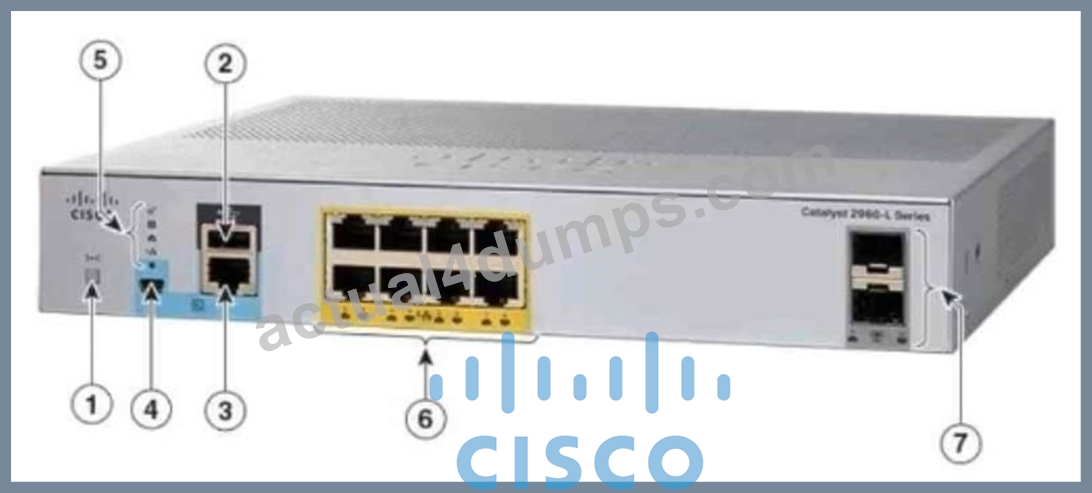
- A. Port identified with number 2
- B. Ports identified with number 6
- C. Ports identified with number 7
- D. Ports identified with numbers 3 and 4
Answer: B
Explanation:
The numbered-6 RJ-45 switch ports are PoE-enabled, carrying both data and power over the same Ethernet connection to an IP phone.
NEW QUESTION # 65
Which two statements are true about the IPv4 address of the default gateway configured on a host? (Choose 2.) Note: You will receive partial credit for each correct selection.
- A. Hosts learn the default gateway IPv4 address through router advertisement messages.
- B. The default gateway is the Loopback0 interface IPv4 address of the router connected to the same local network as the host.
- C. The same default gateway IPv4 address is configured on each host on the local network.
- D. The default gateway is the IPv4 address of the router interface connected to the same local network as the host.
- E. The IPv4 address of the default gateway must be the first host address in the subnet.
Answer: C,D
Explanation:
*Statement B: "The same default gateway IPv4 address is configured on each host on the local network." This is true because all hosts on the same local network (subnet) use the same default gateway IP address to send packets destined for other networks.
*Statement D: "The default gateway is the IPv4 address of the router interface connected to the same local network as the host." This is true because the default gateway is the IP address of the router's interface that is directly connected to the local network.
*Statement A: "The IPv4 address of the default gateway must be the first host address in the subnet." This is not necessarily true. The default gateway can be any address within the subnet range.
*Statement C: "The default gateway is the Loopback0 interface IPv4 address of the router connected to the same local network as the host." This is not true; the default gateway is the IP address of the router's physical or logical interface connected to the local network.
*Statement E: "Hosts learn the default gateway IPv4 address through router advertisement messages." This is generally true for IPv6 with Router Advertisement (RA) messages, but not typically how IPv4 hosts learn the default gateway address.
References:
*Cisco Default Gateway Configuration: Cisco Default Gateway
NEW QUESTION # 66
A user reports a problem connecting to network resources. Other users connected to the same switch are not experiencing the same problem. The user's computer is patched to switch port Gi0/15. The status indicator for his port is blinking alternately green then amber.
What does this light pattern indicate about the status of port Gi0/15?
- A. The port is blocked by a firewall rule.
- B. The port is administratively shutdown.
- C. The port is not connected to a powered-on device.
- D. The port is experiencing a high rate of errors.
Answer: D
Explanation:
On Cisco switches, a port LED that alternates green and amber indicates the port is forwarding traffic but is encountering a high number of errors. This points to a problem such as cabling issues, duplex mismatches, or interface faults affecting communication on that port.
NEW QUESTION # 67
DRAG DROP
Move each protocol from the list on the left to its correct example on the right.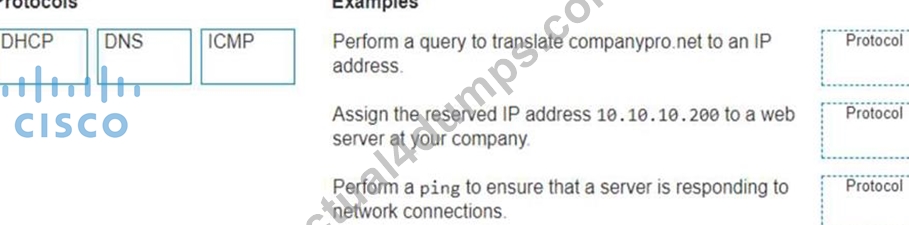
Answer:
Explanation: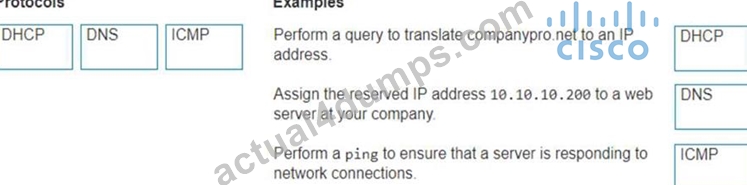
Explanation:
The correct matching of the protocols to their examples is as follows:
DHCP: Assign the reserved IP address 10.10.10.200 to a web server at your company.
DNS: Perform a query to translate companypro.net to an IP address.
ICMP: Perform a ping to ensure that a server is responding to network connections.
Here's how each protocol corresponds to its example:
DHCP (Dynamic Host Configuration Protocol) is used to assign IP addresses to devices on a network.
In this case, DHCP would be used to assign the reserved IP address 10.10.10.200 to a web server.
DNS (Domain Name System) is used to translate domain names into IP addresses. Therefore, to translate companypro.net to an IP address, DNS would be utilized.
ICMP (Internet Control Message Protocol) is used for sending error messages and operational information indicating success or failure when communicating with another IP address. An example of this is using the ping command to check if a server is responding to network connections.
These protocols are essential for the smooth operation of networks and the internet.
Perform a query to translate companypro.net to an IP address.
DNS (Domain Name System): DNS is used to resolve domain names to IP addresses.
Assign the reserved IP address 10.10.10.200 to a web server at your company.
DHCP (Dynamic Host Configuration Protocol): DHCP is used to assign IP addresses to devices on a network.
Perform a ping to ensure that a server is responding to network connections.
ICMP (Internet Control Message Protocol): ICMP is used by network devices to send error messages and operational information, and it is the protocol used by the ping command.
DNS (Domain Name System): DNS translates human-friendly domain names like "companypro.net" into IP addresses that computers use to identify each other on the network.
DHCP (Dynamic Host Configuration Protocol): DHCP automatically assigns IP addresses to devices on a network, ensuring that no two devices have the same IP address.
ICMP (Internet Control Message Protocol): ICMP is used for diagnostic or control purposes, and the ping command uses ICMP to test the reachability of a host on an IP network.
Reference: DNS Basics: What is DNS?
DHCP Overview: What is DHCP?
ICMP and Ping: Understanding ICMP
NEW QUESTION # 68
DRAG DROP
Move each network type from the list on the left to the correct example on the right.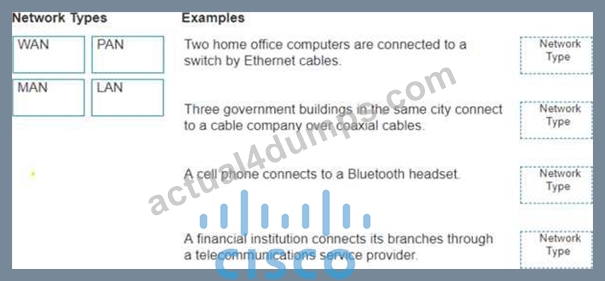
Answer:
Explanation: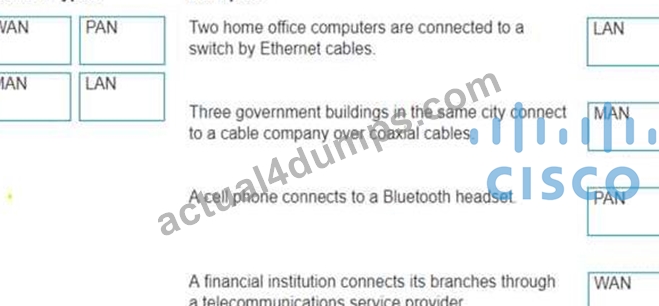
Explanation:
Two home office computers are connected to a switch by Ethernet cables.
Network Type: LAN (Local Area Network)
A LAN connects devices within a limited area such as a home, office, or building, using Ethernet cables or Wi-Fi.
Three government buildings in the same city connect to a cable company over coaxial cables. Network Type: MAN (Metropolitan Area Network)
A MAN connects networks across a city or campus, often using fiber optic or coaxial cables.
A cell phone connects to a Bluetooth headset.
Network Type: PAN (Personal Area Network)
A PAN connects devices within a personal workspace, typically using wireless technologies like Bluetooth.
A financial institution connects its branches through a telecommunications service provider. Network Type: WAN (Wide Area Network)
A WAN connects multiple LANs over long distances, often using leased lines or satellite links provided by telecommunications companies.
LAN (Local Area Network): Used for connecting devices within a small geographical area such as a single building or home.
MAN (Metropolitan Area Network): Covers a larger geographical area than a LAN, typically a city or campus.
PAN (Personal Area Network): Connects devices within the range of an individual person, such as connecting a phone to a Bluetooth headset.
WAN (Wide Area Network): Spans large geographical areas, connecting multiple LANs across cities, countries, or continents.
Reference: Network Types Overview: Cisco Networking Basics
Understanding Different Network Types: Network Types Guide
NEW QUESTION # 69
......
Q&As with Explanations Verified & Correct Answers: https://www.actual4dumps.com/100-150-study-material.html
100-150 Dumps with Free 365 Days Update Fast Exam Updates: https://drive.google.com/open?id=1U6wvQylpz0et2RoDO50YTeT2UGoG3M8C